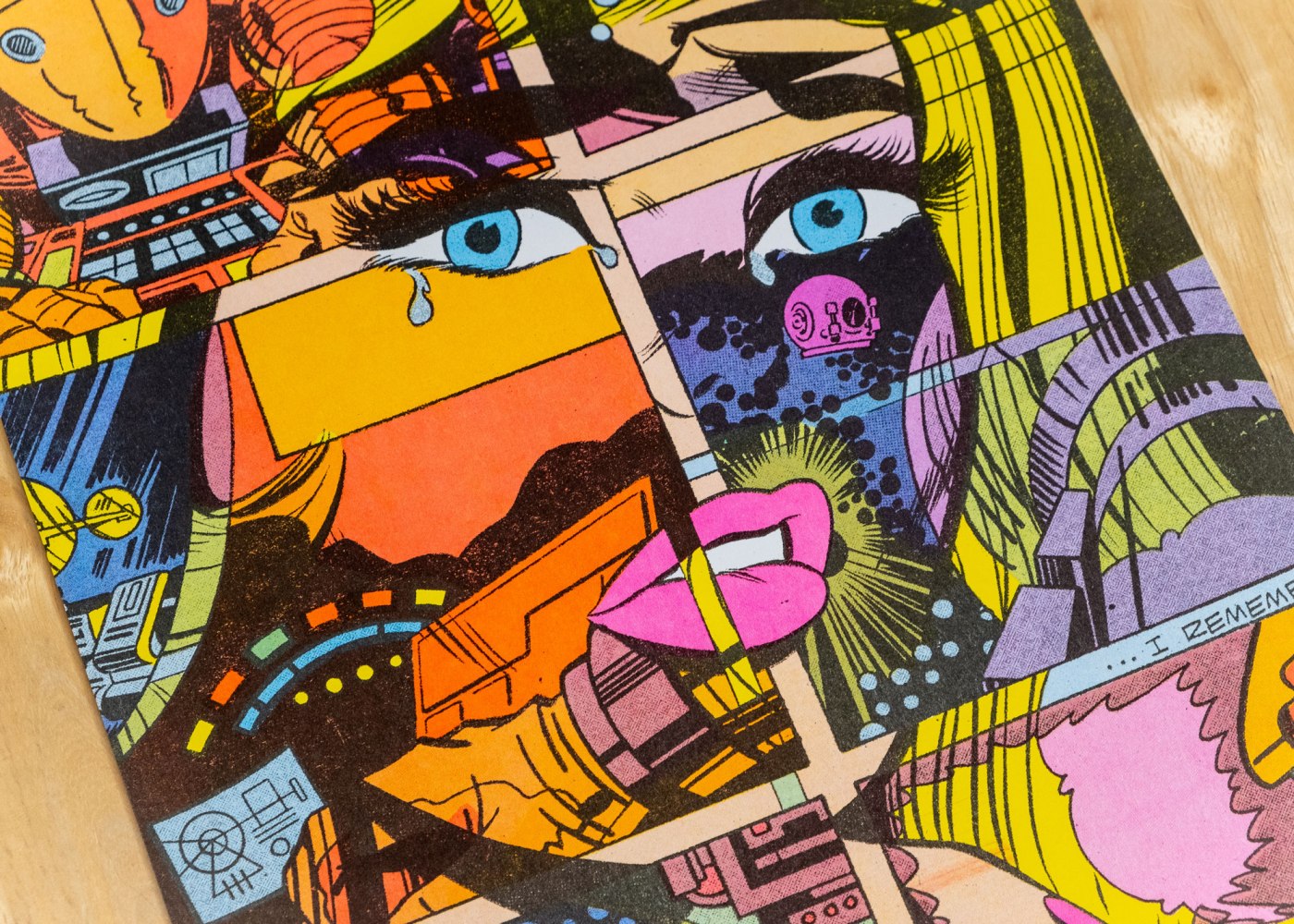
Will Arnold is a collage artist and printmaker, specializing in Risograph prints and zines. Will lives and works in Champaign, Illinois working as a staff member at the University of Illinois at Urbana-Champaign and regularly runs Risograph and zine workshops with students.
Will makes images through a blend of analog and digital collage methods using vintage comics. Will’s zines and prints are published under the name Work Press & Publication, a joint Risograph-printing self-publishing venture founded with Tate Foley. Will is also an organizer for the Champaign-Urbana Small Press Fest (CUSPF) and the St. Louis Independent Comics Expo (SLICE).
To see more of Will’s work visit https://www.twarnold.com or at @t.will.arnold.
Work Press & Publication is at https://www.workpandp.com and @workpress.
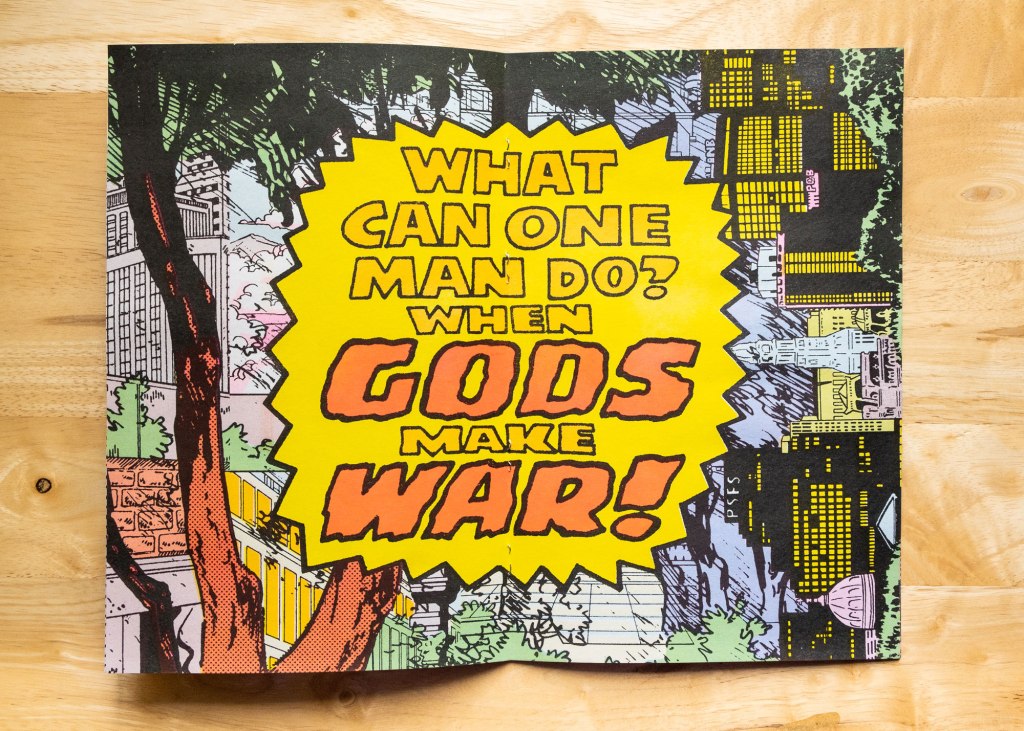
Risograph-printed comic
6.5”x10.25”
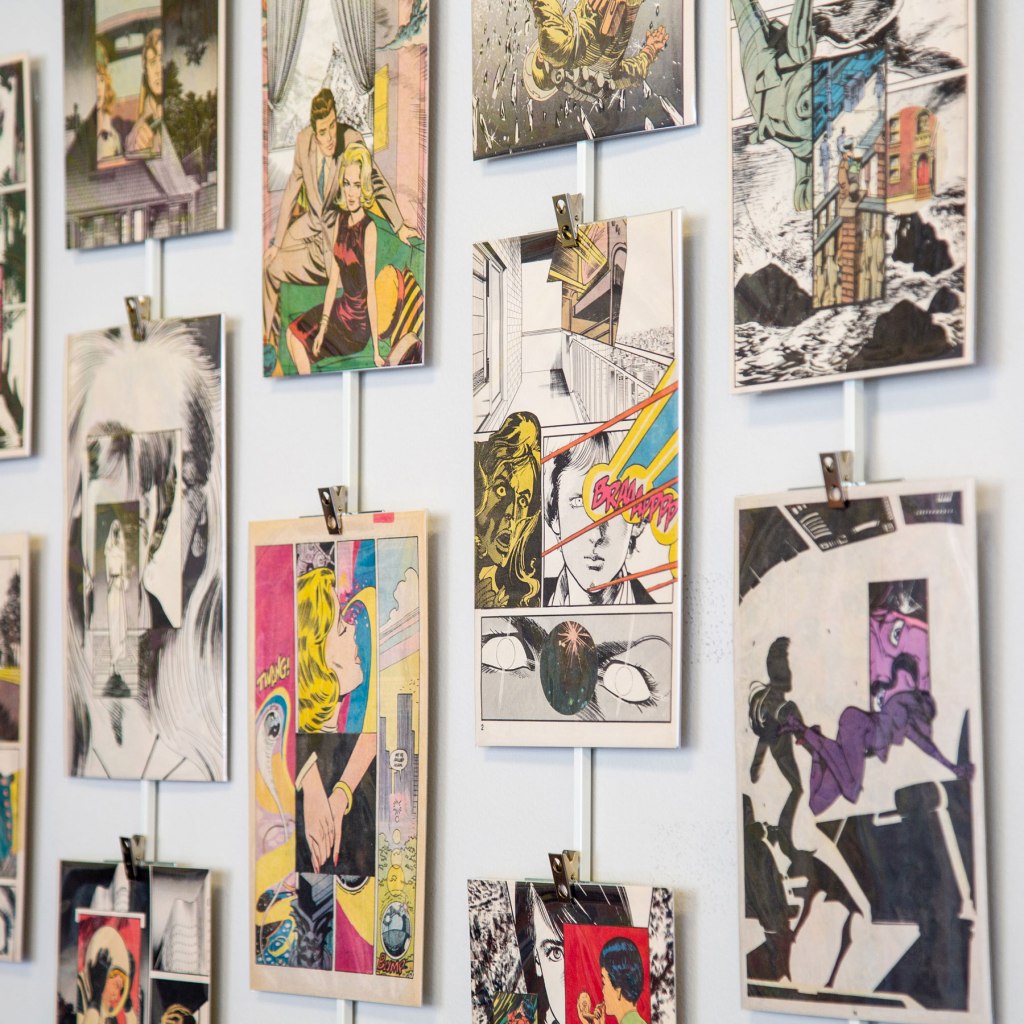
Collaged vintage comics
Variable sizes
Did you grow up reading comics?
Mainly comic strips in the paper and collections of things like Calvin and Hobbes, Garfield, and The Far Side. I read some comic books, loved the early-mid 90’s X-Men. I remember my older brother reading Spawn and some of the other early Image stuff and my dad, who was an illustrator, having a collection of 60’s and 70’s underground books like Zap, other Crumb stuff, etc. I grew into reading a lot of science fiction and fantasy novels, but didn’t particularly stick with comics.
My rediscovery of comics as an adult, both for reading and art-making, was a confluence of a few events. In 2013, my dad bought my wife the first trade paperback of Saga by Brian K. Vaughn and Fiona Staples. He thought that she would love it because she is a huge Star Wars fan and he was right! We were both hooked and that got us back in our local comic book store picking up lots of new series.
Around the same time, my friend Tate Foley picked up a Risograph printer and invited me to come down to St. Louis to try out printing some of my photography work on it. I was just a year or so out of grad school at the time and was pretty burnt out on art-making generally, but I’m always down for discovering a new print technique. I quickly fell in love with Risograph printing and started working on my first Riso photo-zine. Tate and I formed Work Press & Publication and tabled at our first zine fest, the inaugural St. Louis Small Press Expo in 2014 at Firecracker Press. I only had the one photo-zine and Tate had a few books. We sat shoulder to shoulder sharing a 3’ wide half-table and baking in the afternoon sun. But that day totally blew my mind and sealed the deal for my work turning to zines and comics. The whole vibe of the show was so fun, all the artists and visitors were friendly and generous and having a good time. The artwork was affordable and accessible and I met so many amazing artists that day, many who I am still friends with and fans of. I loved the sense of community and camaraderie. That day, and all the comics and zine shows that followed, opened my eyes to the amazing independent comics work that was (and is) happening outside the major publishers.
Shortly after that, a friend of mine, Sophie McMahan, who makes amazing comics and art inspired by vintage horror and romance, gave me a stack of 60’s and 70’s romance comics. Reading those books really kickstarted me into exploring from that era, which led to the creation of several zines such as Boys in Love and Tom Corbett Love Cadet where I made remixes of romance and sci-fi genre comics which ultimately set me on the path to where my work is now.
That convergence of discovering the amazing things contemporary comics artists were doing through both mainstream and independent channels, while also diving into the visual and thematic richness of comics history was a turning point for me. It reshaped my relationship with the medium completely.
Trying to capture and share that feeling of realizing there’s a whole other side to something you thought you already knew is a big part of why I make the work I do. Through my work at the University of Illinois, and as an organizer of CU Small Press Fest and SLICE, I try to pass that feeling along. Comics are everything you remember from childhood… and so much more!
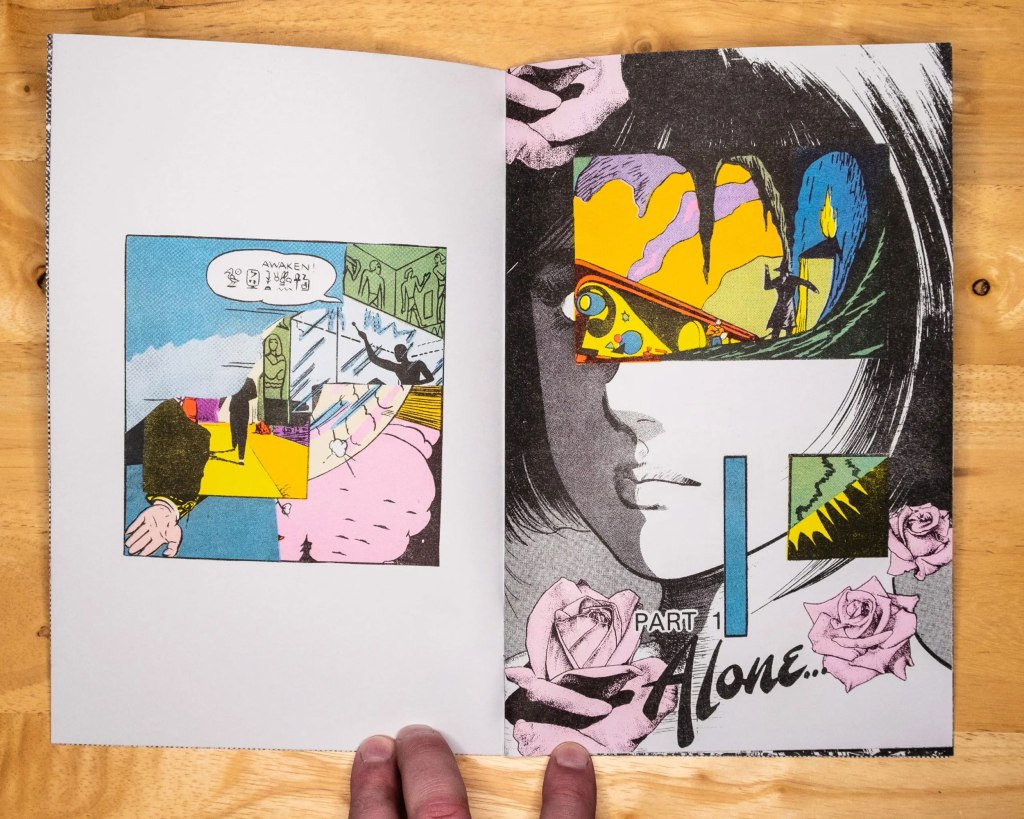
Risograph-printed comic
6.5”x10.25”
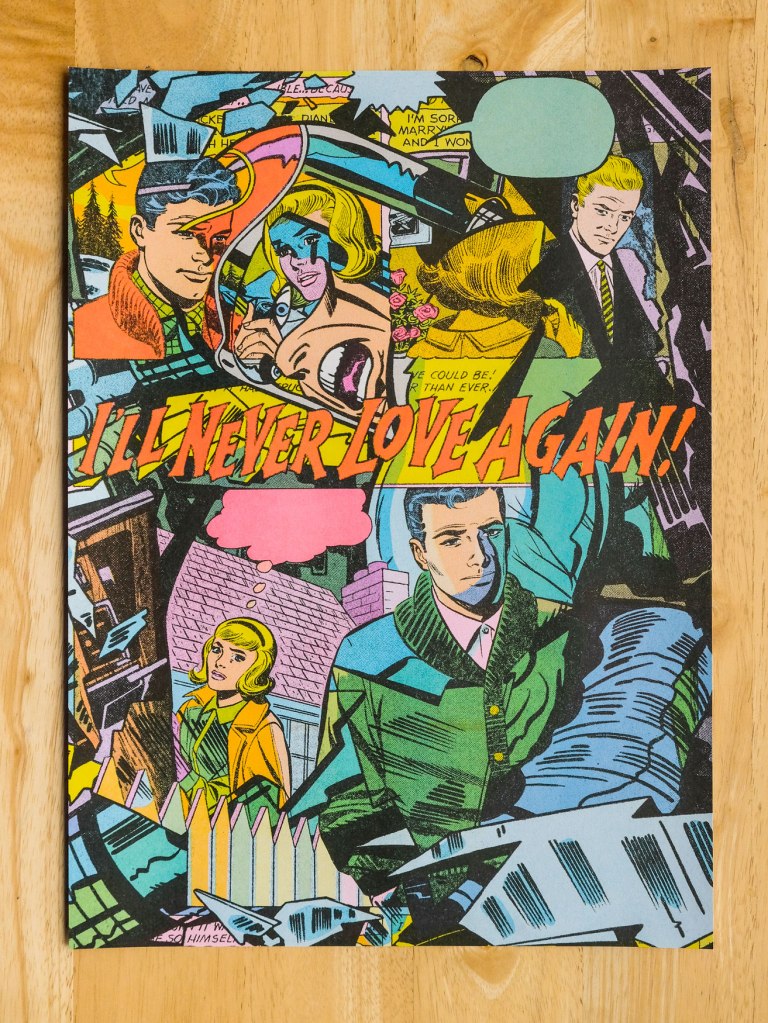
Risograph prints of collaged comics
10”x14”
Do you have a favorite comic shop that you visit? Where is it? What makes it so great?
For new comics to read, Floating World Comics in Portland, Oregon. Walking into Floating World is like walking into an independent comics show like SPX or CAKE or CXC. There is so much good small press and self-published work there and I always discover new artists, as well as new work from old favorites. They also do some publishing themselves and have put out some great stuff, I’m a particular fan of Steve Aylett’s Hyperthick and Teddy Goldenberg’s City Crime Comics. They’ve even stocked a few of my books there, so I may be a bit biased! We don’t get out to the West Coast super often, but whenever we are in Portland, we make a point to stop there.
For old comics I recommend Jim and Dan’s Comics and Collectibles in West Alexandria, Ohio. They have a large and well organized stock of vintage comics that they cycle through regularly, including a good selection of affordable reader-grade romance comics, which can be tough to come by. They also have some great dollar boxes that I always find something good in. They are on our drive from Illinois to where our family lives out East, so we try to stop in a couple times a year as we make the drive back and forth.
Mostly, whenever we travel to a new place, my wife and I try to find the local comic shop and check it out. There are so many gems out there!
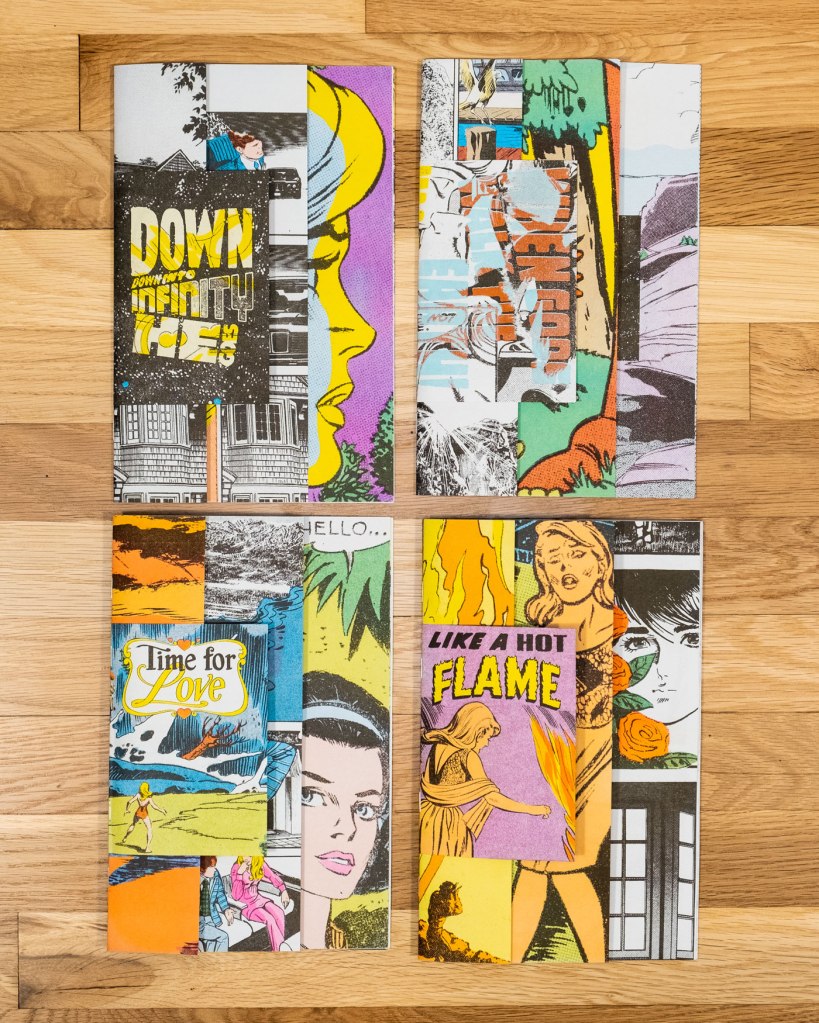
Risograph-printed comics
6.5”x10.25”
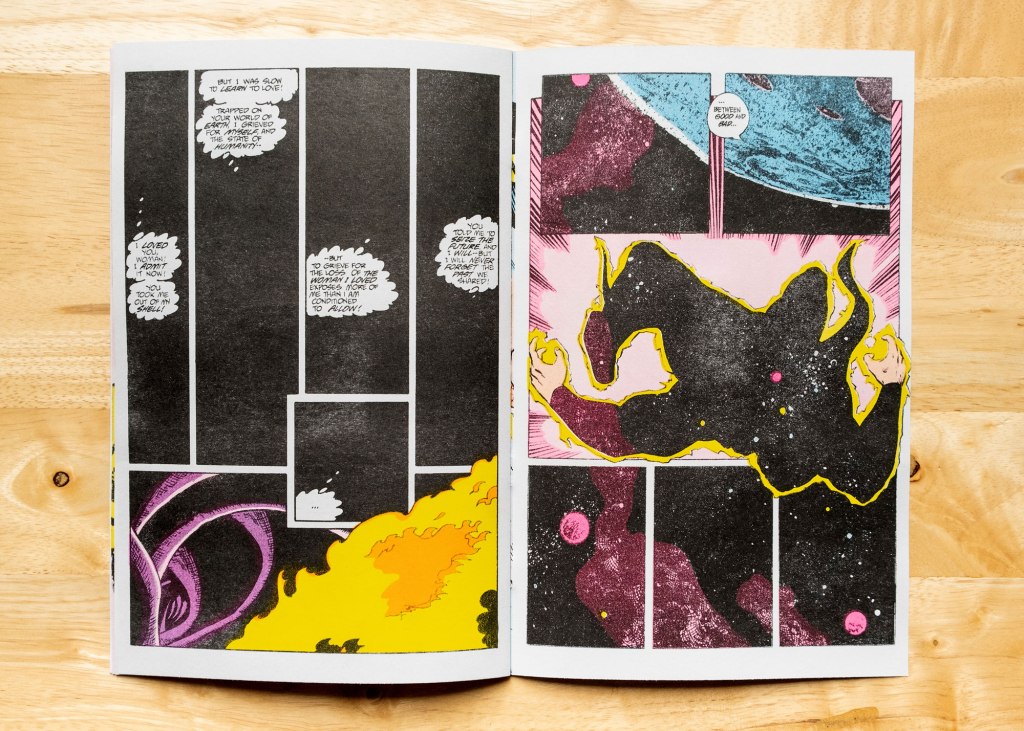
Risograph-printed comic
6.5”x10.25”
How do comics inspire or inform the work you make?
I’ve always felt that I’m a better editor than creator. Anyone who draws or writes knows about the fear of the blank page. So, I’ve always done better when I have something to start from, something to adapt. Even in my photography days, an image always began as a thing that existed in the real world. Nothing comes from nothing, as they say.
Comics are both the content and the raw material of my work, the building blocks I use to piece things together. I will cut them up and collage them physically as well as scan and rework them digitally. In recent years, I’ve taken two main approaches to making work. One way is to make a twist or intervention within an existing comic to turn it into something new. The other is a more traditional collage method, where comics are deconstructed and used as visual and narrative elements to build an entirely new work.
For example, Ghostland is an intervention project where I removed all characters and dialogue from old Casper the Friendly Ghost comics, creating a loosely narrative story composed entirely of backgrounds and empty environments. In Boys in Love, I swapped the male and female dialogue in vintage romance comics to explore shifting, or stagnant, gender dynamics in popular media across decades. In both cases, I’m explicitly engaging with the historical and cultural context of the original material.
On the more collage-based side, I recently completed a series based on T.S. Eliot’s The Four Quartets. Each of the four books responds to one of the four poems, combining his text with imagery and language sourced from a wide range of comics. Threads and themes of romance, isolation, time, and memory cut across the source material and are woven together into something new. Of course, even in the more collage-based pieces, the final result is still referencing the historical context and visual culture of the source material by virtue of its aesthetics and recognizable structures and tropes, but in a less direct way than the interventions.
Mainly, I love working with comics because it gives me an excuse to spend time with them, to engage with the material and the history. I love having a reason to go digging through long boxes in the basements of comic shops, flipping through the pages looking for the right detail that I can use. For example, I love Silver Surfer. So much of those stories are just him floating through space, lost in existential angst. It’s like the cosmic version of a romance comic: characters asking what it all means, wrestling with love, loss, longing, and loneliness. I’m not interested in creating new Silver Surfer stories or even directly referencing the character, but I do love pulling elements of his cosmic monologues, the expansive starry backgrounds and weaving them into new works. In The Four Quartets series, for instance, you’ll see those Silver Surfer elements paired with Eliot’s poetry and romance comics and more. The work I make is an excuse to dive deep into the comics I love and bring their textures and themes into a new conversation.
The printing method I use for my prints and zines is also inspired by comics history. I use a faux-CMYK process on the Risograph where I will print color flats using the Riso’s yellow, fluorescent pink, and aqua inks and top that with my black line work. This method echoes the traditional CMYK offset printing used throughout comics history that combined color flats with black-inked line work. You can see an example of that here.
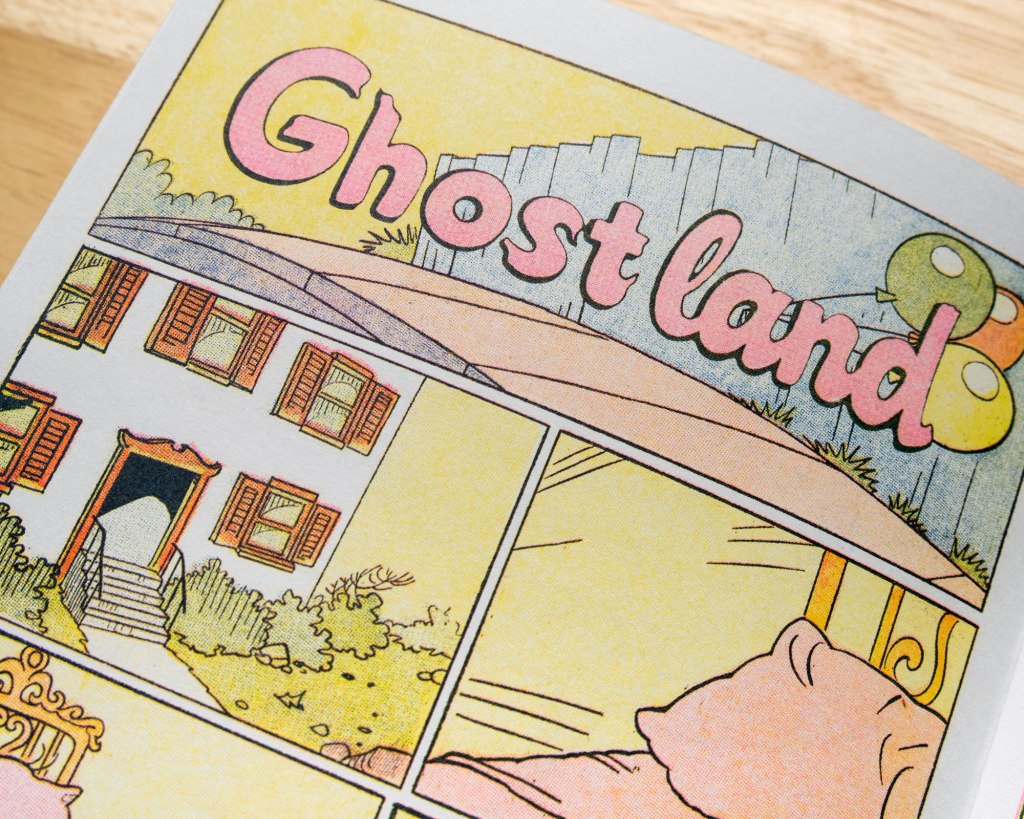
Risograph-printed comic
6.5”x10”
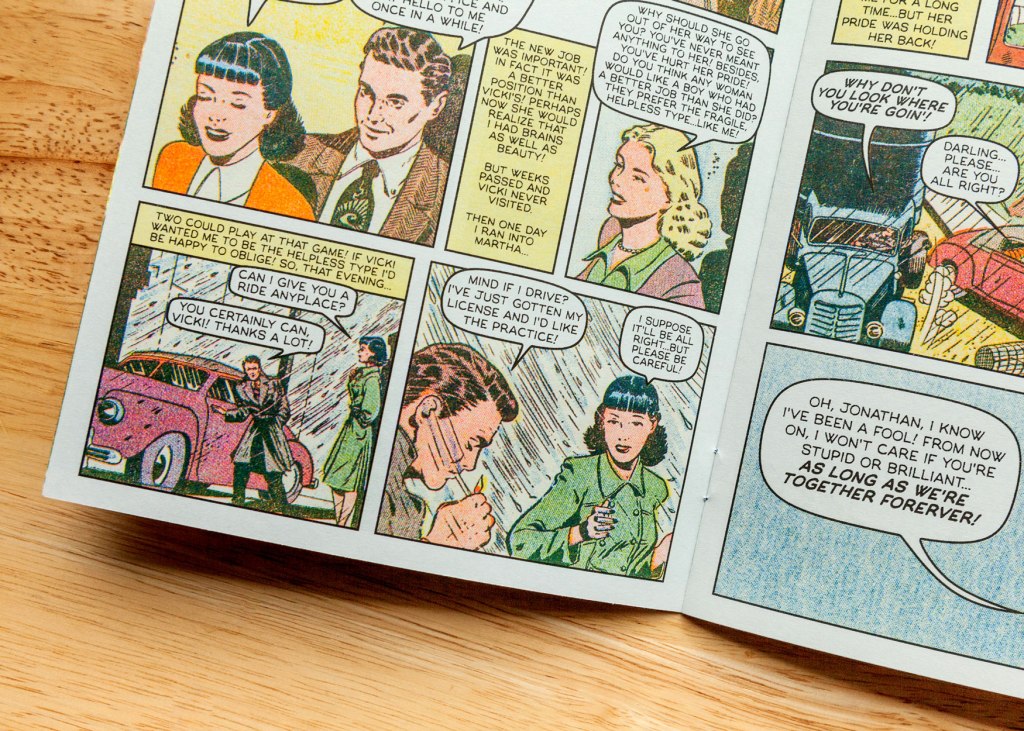
Risograph-printed comic
6”x8.5″
Have you ever been afraid or worried about making artwork that references comics?
Maybe not “afraid,” but one concern I’ve always had as a collage artist working with comics is the potential for misunderstanding of my work or my intentions. I always try to be clear that I’m reusing, manipulating, and collaging existing imagery and text, but not all audiences hear that. Especially at independent comics shows, where most of the exhibiting artists are illustrators, people often assume I’m an illustrator working in a retro style rather than a collage artist recontextualizing vintage material.
At a recent show, someone complimented me on my “excellent execution of Kirby Krackle” in a print. When I explained that it was actually a collage using some Jack Kirby panels, they responded by saying how excited they were to see a new generation of illustrators embracing the old style. I tried again, saying “I really like the texture of Kirby’s work and enjoy using it in collages of old comics”. But they just smiled, repeated that they liked it, and bought the print. At that point, I just said “Thanks, glad you enjoy it.” Sometimes that’s all you can do.
I also inevitably get the question of “how does this work fit into copyright law” etc? I do not pretend to be a lawyer by any means, but of course collage artwork has a long, though sometimes contentious, history with the law. In general, I believe it is acceptable to use the copyrighted imagery within the context of collage. Even if I use a recognizable character like Superman, I am clear that I am not trying to create a new Superman story or claim any sort of ownership over the likeness or character, it is just a piece of a larger artwork. Where it is relevant, I do my best to cite my sources. Of course, when you are pulling bits of cut paper out of drawers and piecing them together into a collage, it can be untenable to track the provenance of every scrap. But if a particular source is a major component of a piece I am working on, I will cite it when I can.
That said, I often avoid highly recognizable characters altogether. I tend to work with genre comics – romance, horror, westerns, sci-fi – because they’re more episodic, and their characters are more interchangeable. To most people, two different cowboy characters might just read as “cowboy,” even if a serious fan could tell Kid Colt from Rawhide Kid at a glance. In those cases, a viewer’s familiarity with comics history can add layers of meaning to the piece. I like when someone with no comics background can simply enjoy the work for what it is, but a deep comics nerd can pick it up and say, “Wait, is that Kirby’s 2001 mixed with Marshall Rogers’ Silver Surfer and romance panels by Art Cappello?”

Risograph print of collaged comics
10”x14”
 Not Approved by the Comics Code Authority...