Barbara Lane Tharas (they/them) makes autobiographical and fictional comics that are meant to create opportunities of solidarity for folx who are experiencing things like: anti-fat bias, PTSD, BPD, depression, ADHD, family dysfunction, isolation, loneliness, or just feeling misunderstood and like we don’t belong. They currently live and work in Emporia, Kansas
You can find examples of their work on Instagram @bltcomicz and at barbaralanetharas.com. On their website, you can read the Garen’s Diary Volumes I and II and A Girl Named Seattle.
In person, you can see Barbara at the annual KC Zine Con and Paper Planes Zine Fest. Garen’s Diary I and II are available to purchase at Quimby’s Bookstore in Chicago and Wonder Fair in Lawrence, KS. Early comic work can be found on a Tumblr created a long time ago, very early BLT Comicz.
Barbara will also have a piece in a collaborative risograph book called Inhaler being published by previous Not Approved… interviewee Andrew Kozlowski…Coming out soon!
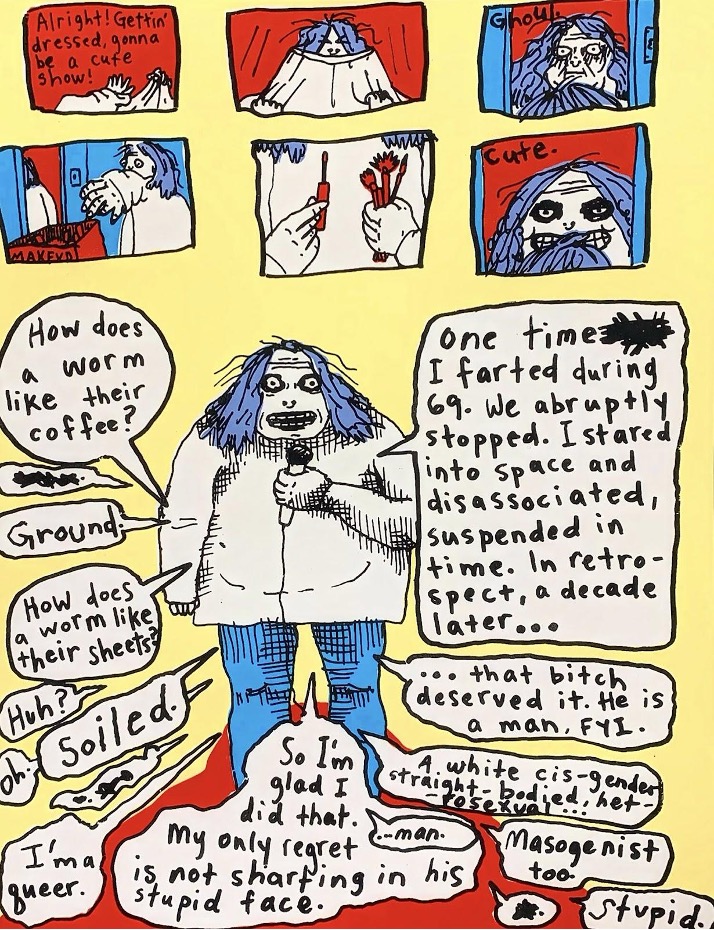
Screenprint, 9″ x 11″
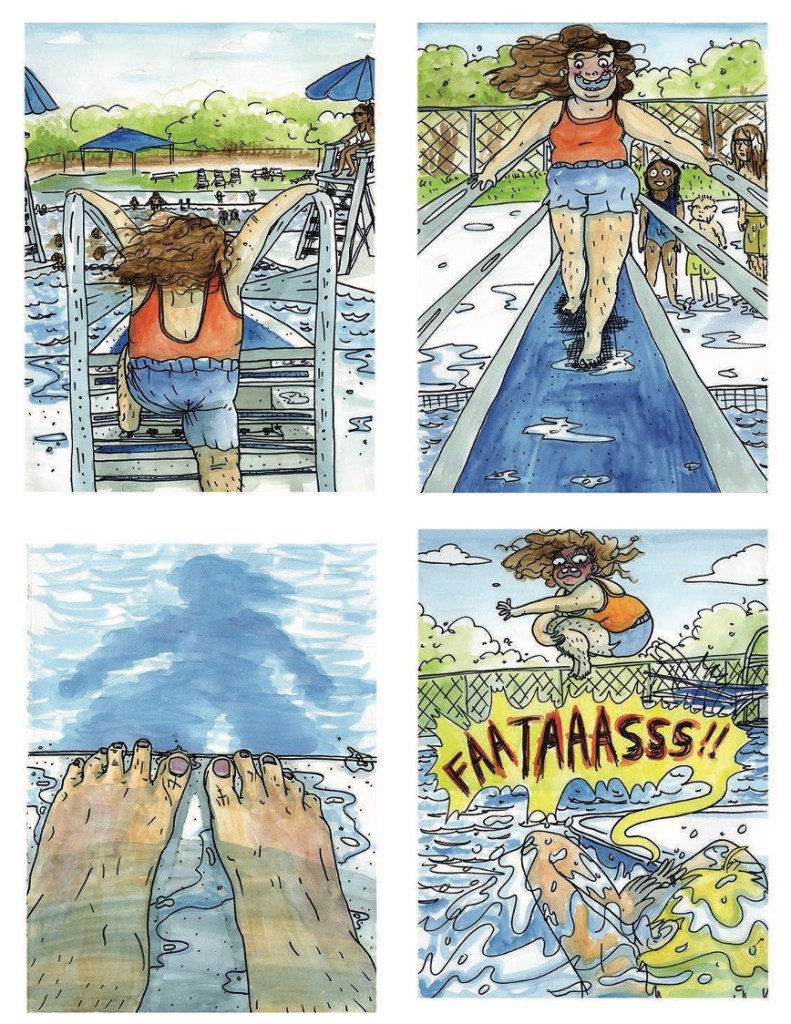
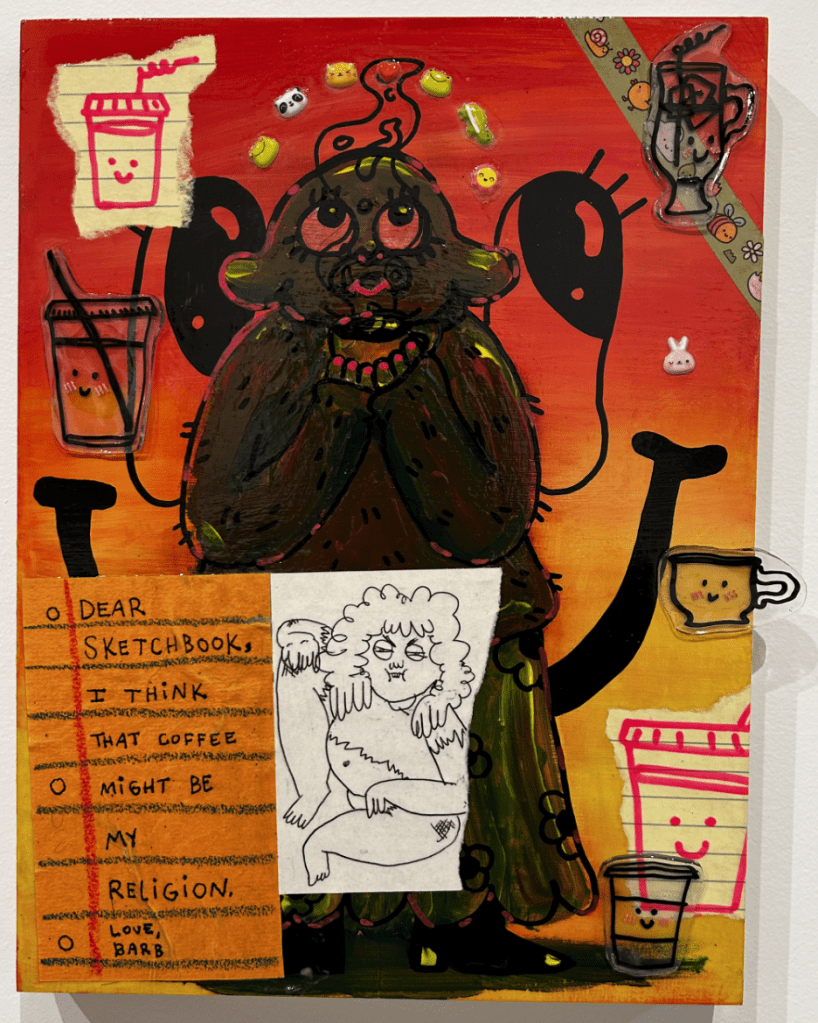
Watercolor, Ink, 11″ x 14″
Did you grow up reading comics?
I actually started making comics before I knew what they were. I was about 4 years old. We lived with my grandparents at the time who had a massive collection of VHS tapes that included many recorded Disney movies. My Grandparents’ house, which we knew as The Ranchito, was basically my first Netflix and art studio. There, we had loads of scrap paper, crayons, pencils, markers, and pens. I watched princess movies and then drew my own princesses with swans and horses (there were always horses), adventuring and coexisting in river scenes and flying through sunsets. I also drew my family, surroundings, houses, and farm animals. So just like today, I drew autobiographically as well as fictionally. I didn’t learn to read until about first grade, so everything I was drawing was visual and didn’t have any words except for maybe “AHHHHH” or other onomatopoeias.
We moved to a small town outside of Corpus Christi called Ingleside when I was six. We were very poor. So I was not able to consume media like cartoons or comics the way I craved. This was a huge reason I drew my comics too. Remembering the magical movies at my grandparents house, I would draw what I needed to see in order to satisfy that craving. In first grade, I was heavily influenced by Lisa Frank, and owned a Lisa Frank pony diary, complete with a tiny metal clasp. I covered that thing in comics, diary entries, character designs, dirty secrets, and stickers.
By second grade, my characters were girls who did all the things that I wanted to do but couldn’t, either because I didn’t have the money or because I didn’t have the friends. They had love interests and horses to fulfill these fantasies in real life. My character aesthetic was Bratz doll meets Powerpuff Girls meets the Lizzy McGuire cartoon.
Huge eyes were a big thing for me. I remember the sensation I felt the first time I saw Powerpuff Girls on TV. It was like “YES THAT’S IT!” Finally, someone had done it! Huge-eyed girls will rule the world finally! I don’t know why the huge eyes got me so much, but they did. I also really loved the way old My Little Pony cartoons were drawn, but I couldn’t figure out how to draw them. I remember seeing the Archie comics and loving the way Betty and Veronica were drawn, but I didn’t really relate to their lives. They were just too emotionally schticky and surface level for me to really dive in with investment. I don’t recall being exposed to comics as a child otherwise.
As I got older, like in junior high and high school, making art was less and less encouraged, until it was fully discouraged, by my parents. At that time, the only media I really consumed was either live action movie theater movies – like Lord of the Rings and Napoleon Dynamite – or TV shows – like Chappelle Show, Tim and Eric Awesome Show, South Park, The Daily Show, The Colbert Report, Aqua Teen Hunger Force, The Boondocks, Squidbillies, Metalocalypse (my brothers and I were in love with this one), Superjail – and so much more.
I went through junior high excelling in my art classes, but by the time I got to high school I didn’t make any art at all unless it was for an assignment in a non-art class. Discipline was enforced by my dad and he put a huge focus on me being the best student athlete in town with impeccable grades and softball stats hoping for an athletic scholarship to pay for my degree.
Then college happened and nothing went according to plan. My dad disowned me, I quit softball, my college grades suffered, I was diagnosed with major depression, and I experienced a painful journey back to art.
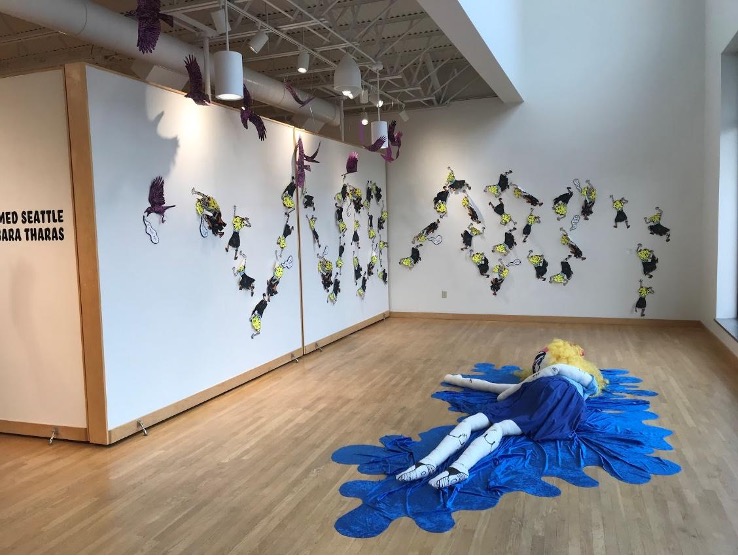
Screen print, Soft Sculpture
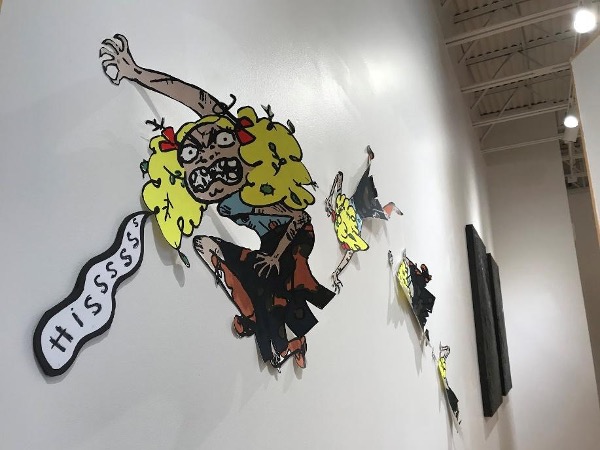
A Girl Named Seattle Exhibition
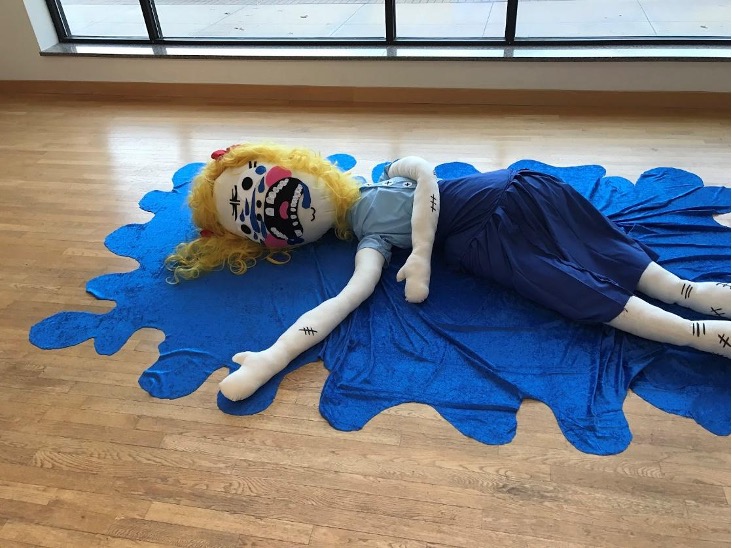
A Girl Named Seattle Exhibition

Screen print, 11″x14″
Is there an important comic shop or friend who opened your eyes to comics?
I would say that the two people early on who opened my eyes to comics were Joshua Schaefer and Rebecca Lyons. I am not friends with Josh anymore, and even though Rebecca and I have kind of fallen out of touch, I still consider her a dear friend.
At the start of my college art career, I entered myself into the sculpture program and became friends with Josh, who was really into comics. We are now estranged, but he lent me several of his comics including Superman Red Son, Batman and Umbrella Academy. I can’t remember what Batman comic it was exactly or who the artist was, but I remember it making an impact on my view of comics because the art style was scary and grotesque much like my style at the time. I didn’t realize that comics could be like that, and it definitely piqued my interest.
After having a falling-out with Josh, I went through a bad depression. I remember in my early 20’s, feeling like an unlovable failure. Loading heaping bowls of Bluebell Homestyle Vanilla ice cream acquired from a gas station, then locking myself in my desolate apartment bedroom while my roommates laughed so hard in the living room. Rebecca suggested reading Watchmen and Maus, and let me borrow her copies. I binge-read Watchmen and it felt so good. I didn’t know I could escape into a comic like that before that dark experience. I did the same thing with Maus, and it felt like I was escaping my life and being taught firsthand how to persevere by watching these other lives do it under incomparably worse circumstances. It felt like I was consuming a real experience via a comic book starring mice. It was profound and eye-opening. I would say those two comics are the ones that really created my relationship to comic books. Shortly after Maus, I read Persepolis and that one had a huge impact on me as well. These comic books did things that regular books couldn’t do. They did things that movies and shows couldn’t even do. They felt so real. The problems were real, and the struggles were real. That realness made me feel solidarity before I had ever heard that word. Empathizing with the people experiencing these earth-shattering tragedies inside a comic book stuck with me deeply and was an incomparable experience to any of the DC or Marvel comics with superheroes and aliens.
College continued to happen, and I was swept away by the demands of being a floundering college student forced to survive, leaving no room to explore comics. My phone was not smart yet and I could not explore as leisurely as we can now.
Around 2011, I dropped out of college at Texas A&M University Corpus Christi(TAMUCC), to work as a night stocker at Walmart for six months in order to save enough money to move to Austin. I was feeling stuck and isolated in Corpus Christi and wanted a better life for myself. I was feeling like Austin had more going on, and that I could become more successful there. My main interest at that time was studying film.
During my time at Walmart, I had some of the bleakest experiences of my life. After night stocking with drug-addicts, lost boys(like me), predators, and a few honest hard-working folx just trying to survive, I would come home to my grandma’s couch at 7am. Spending a whole night enduring the lights, the hard floor and the hot temperatures made a shower feel like a million dollars. Curled up in a blanket on the couch while everyone else started their day, I would watch clips of Adventure Time on my new little smart phone with a slide-out keyboard. I wasn’t into the show at first, but once I caught the “Slow Love” episode, the show really lit up for me.
Watching clips of Adventure Time on the Cartoon Network website from my smartphone was the only thing that could really make me laugh or feel any joy. I would get home from work and feel isolated and hopeless. I found Adventure Time at a moment when I was searching the world high and low, frantically clinging to any sort of meaning, purpose, or fulfillment I could find. I felt at ease watching those clips, and I was starving for more. I would re-watch the same clips or episodes, over and over, and feel a little less alone.
Eventually, I learned about Pendleton Ward and I learned everything about him that I possibly could and consumed all of the media he was associated with, from his comics to napkin drawings that he posted on his twitter. I learned about some of the people that worked on Adventure Time with him, JQ Quintel, Rebecca Sugar,and Natasha Allegri and followed all of their social media and learned all I could about their lives and journeys. I became obsessed with Jesse Moynihan‘s “Forming”, his website is a wonderland.
I decided that I wanted to make art that does for others what Adventure Time has done for me. In my mind, the best way to do that was through an animated film or show. But animation is really hard, and I haven’t quite found my groove with it just yet. My main groove right now is definitely comics.
One night, I was hanging out with my brother Nathan and my cousin Franklin. We were all walking to a local bar called House of Rock. Crossing that grassy median dividing Ocean Drive into a two-way main street, I called out to both of them, “Hey do y’all think I should pursue making a cartoon?” Without question, they both yes. That was the push I needed to dive into this dream. Two people I loved and trusted believed in me. And to this day, making a cartoon is my ultimate career goal.
From there, I fully committed and re-enrolled at TAMUCC after realizing that neither Austin nor CalArts were financially possible for me. I decided I would do my best with what I had, and my drawing style burst out of me like a creature of its own fully influenced by the styles of Pendleton Ward, Thurop Van Orman, JG Quintel, Rebecca Sugar, Jesse Moynihan, and Natasha Allegri. You can catch a glimpse of some of that early work here:
https://www.deviantart.com/btharas/gallery
Learning that storyboard artists were the comedic brilliance for all my favorite cartoons and that storyboards are basically comics, my view of comics changed again. I latched on hard from there. Comics were something I needed to have from then on. I started collecting in 2013. I mostly went for comics at my local Half Price Books, and comic book stores like Texas Toys and Comics Plus. They didn’t offer as much as places like Quimby’s or Copacetic, but they provided Adventure Time and Regular Show comics which were exactly what I was after at that time.
These days I like to buy comics directly from artists at zine cons, their Patreon pre-orders, or from their websites. If I find myself at a comic book store, however, I spend all my coins on comics. It’s a problem!
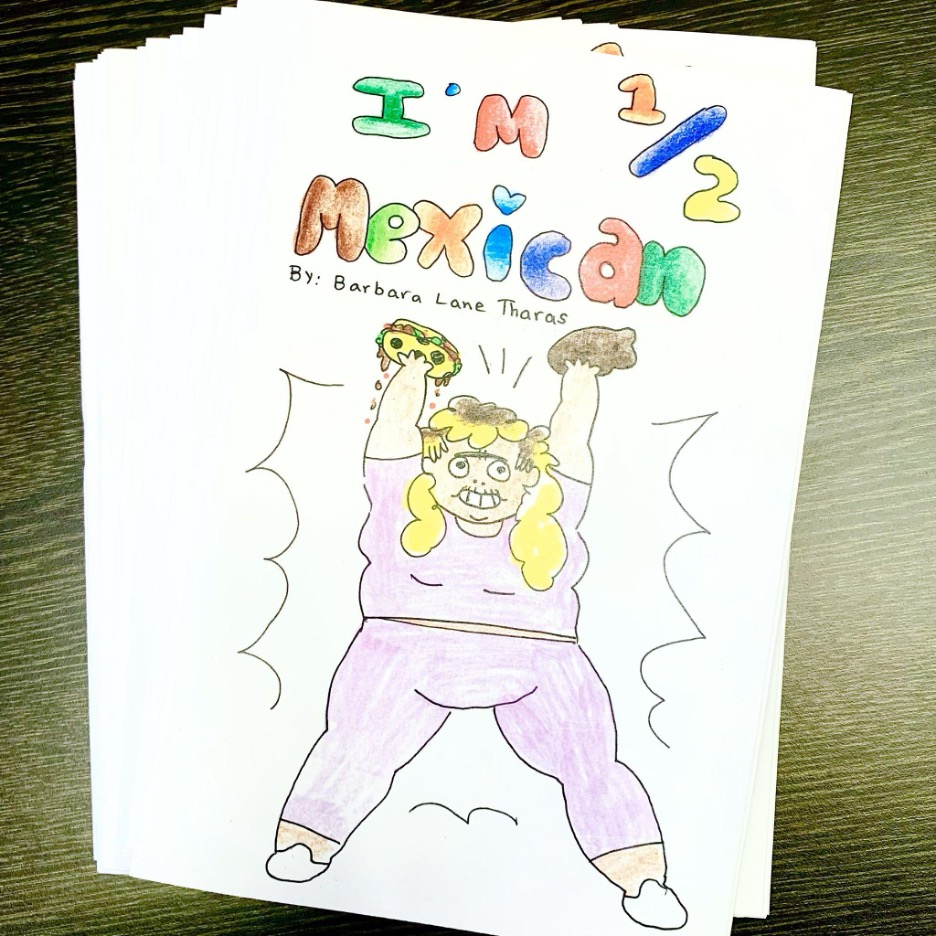
ZINE
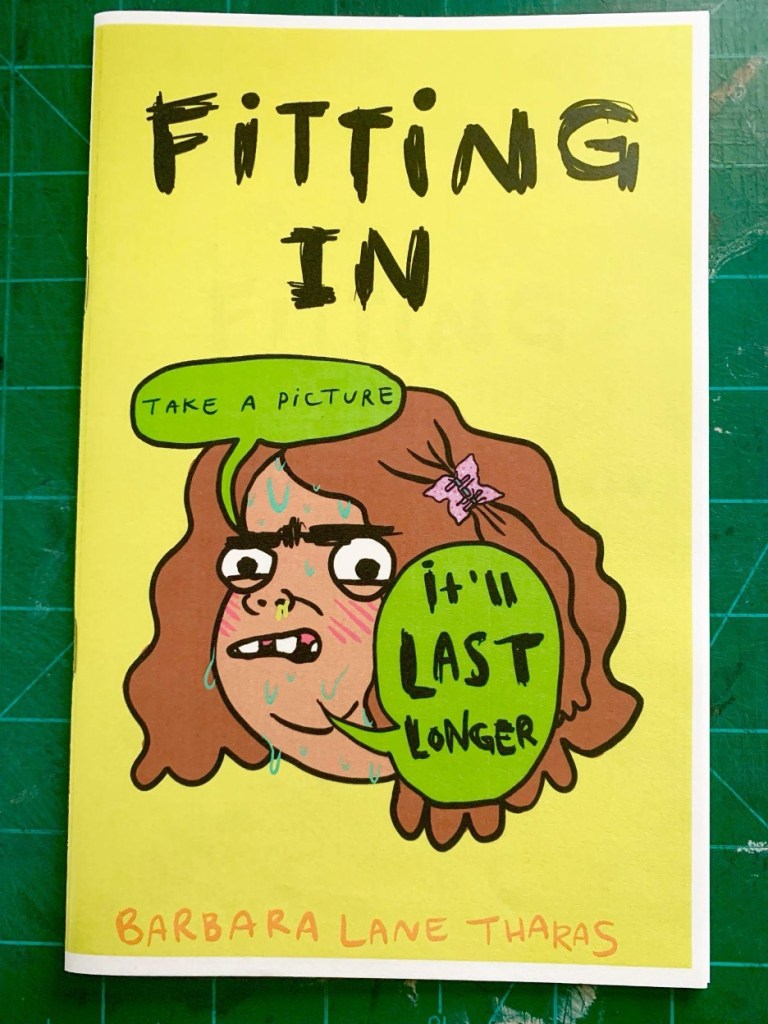
ZINE

How do comics inspire or inform the work you make?
Storytelling. I am obsessed with the way a story is told via sequential drawings. The comics I consume inform me of the visual languages available for telling stories. The ways in which stories are told via comics are special because it’s not just about dialogue or logistics of things moving through space and time, it’s about how a moment FEELS. Comics can strip a feeling down to its core elements and present that experience in a hilariously economical way. A comic can be so simple, yet so incredibly commanding in its ability for profound solidarity and relatability. One simple black and white doodle can stop someone dead in their tracks, epiphanized.
I really enjoy the exploration of the economy of line, color, composition and stripping my art down to its core elements. Simple lines that are specifically placed, drawn quick and erratically or slow and carefully will communicate potent feelings. If I want a facial expression to read a feeling as heavy and still, I will draw the lines of the face slow with a slight shake. If something feels sporadic, chaotic, and fleeting, I’ll draw it with a lighter, quicker hand. Ruby Elliot’s drawings show this dichotomy of line so deliciously. The hand composes the way the eye will read, and that has a lot to do with the feelings that get generated upon viewing.
Generating backgrounds in my sequential work is still something that I am not totally satisfied with. Jillian Tamaki’s backgrounds can be succinctly simple yet effective like they are in much of Super Mutant Magic Academy or massively enveloping like in This One Summer. I remember the first time I read This One Summer , I was plunged into that world because of the intricate backgrounds. All of the cartoons and films and comics I love to dive into are so satisfying to exist in, because their backgrounds serve as a portal! Rendering a space and the objects that occupy that space so that they convey the feeling of being in that space is just so overwhelming and powerful.

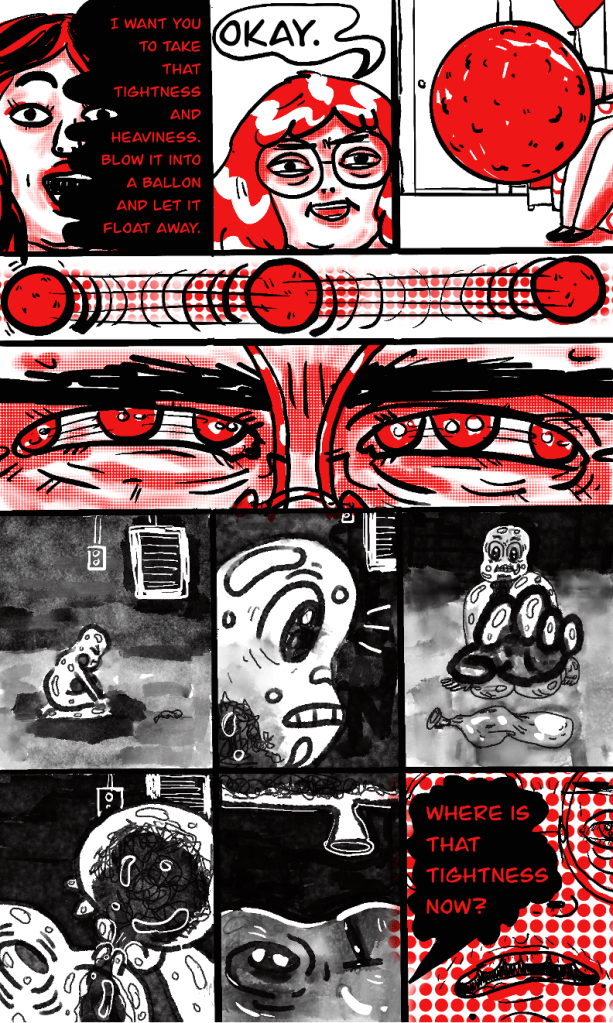
Page 01
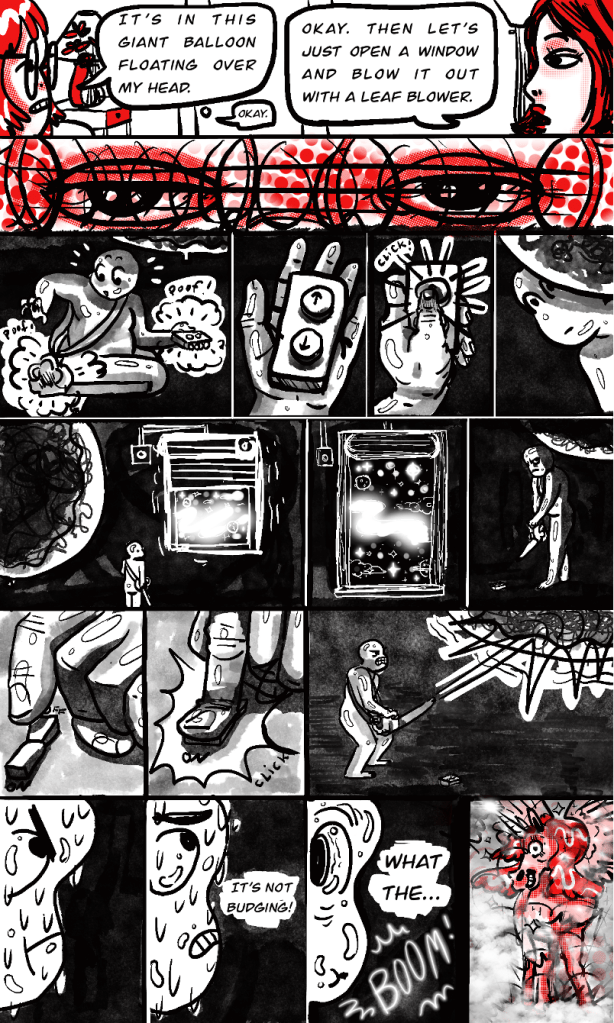
Page 02
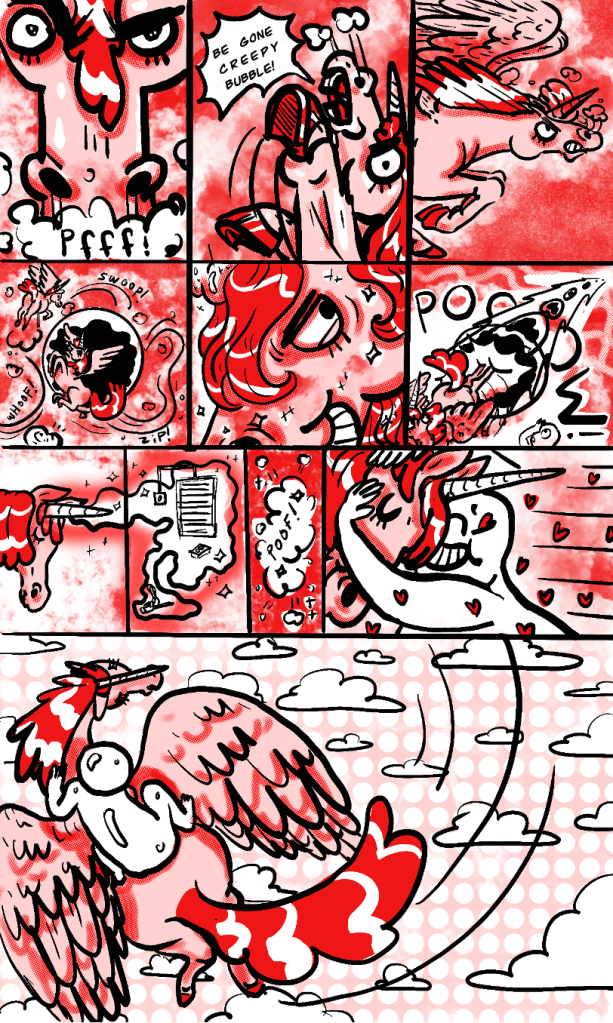
Page 03
Page 04
How long have you been making work that references comics?
When I went back to college for the second time in 2012, I had cartoon-making in mind and my style of drawing reflected that. I would draw very comic-y imagery in drawing and printmaking classes.
I really started to lean into making comics when I discovered Tumblr and Ruby Elliot in 2013. I remember laughing so hard and identifying with Ruby (rubyetc) through her comics and drawings. One of the first comics I made recounts my experience scrolling Tumblr, reading Ruby’s comics, and feeling comfort at the newfound belief that I was that much less alone in my experience as a person with a mood disorder. AND SHE MADE ME LAUGH WHICH FELT AWESOME! After I posted that comic and tagged her in it, she shared it to her followers and it boosted my confidence a ton.
In those days (my mid to late 20s in 2011-2017), laughter truly was my greatest medicine. I was addicted to laughing and making others laugh. And honestly, I still am.
My comics on Tumblr took off. My fellow art students, my professors, my family, my friends, Ruby, and even strangers on the internet were raving about my sharpie-on-printer-paper comics that were scanned then posted. I mean people really REALLY liked them! I felt like I had reached a milestone in my life, and I’ve been making comics on purpose ever since.
My first sequential show was my BFA show at TAMUCC. With lots of help, I built six 3ft x 4ft wooden panels, and adhered printed-out posters of my tumblr comic, Dear Diary onto those wooden panels.
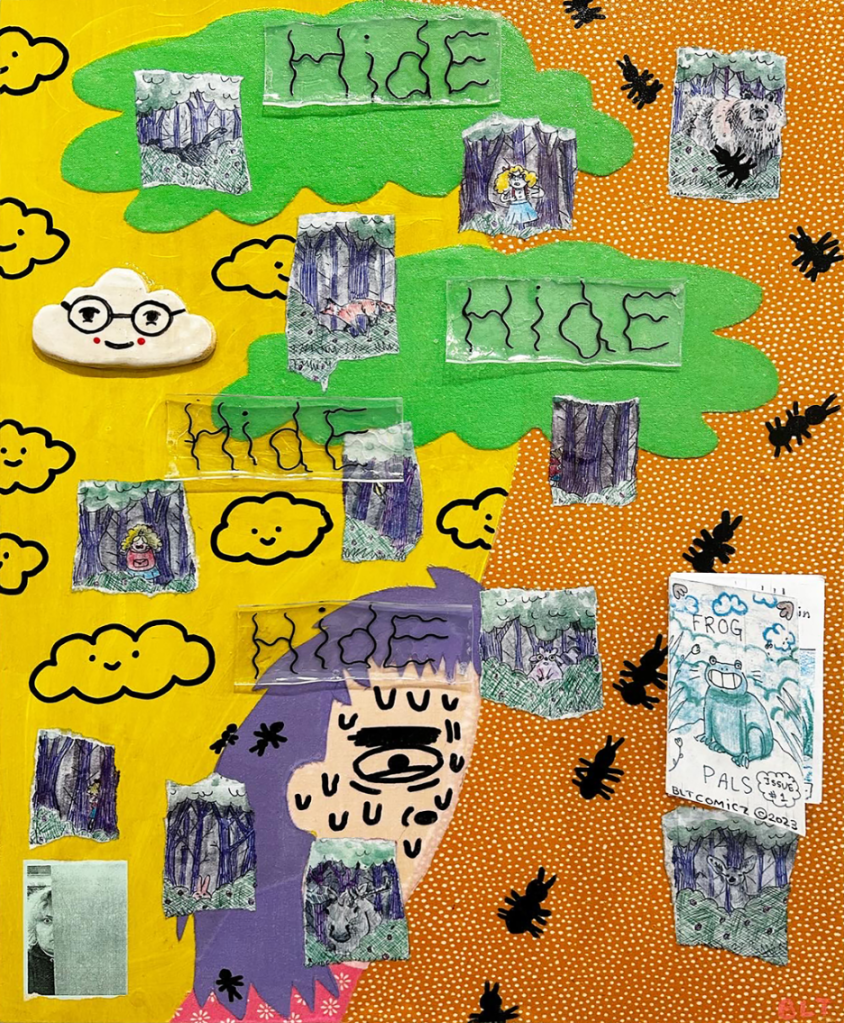
In 2018, I made Seattle’s Hike. It was a sequential story of Seattle hiking through the woods because she is mad at her family. I used acrylic paint on wood panel for the backgrounds. For the foreground and main characters, I made collages made of pressed flowers, sharpie drawings on lined notebook paper cut-outs, imagery from national geographic magazines, and ferns from my bedroom.
I’ve had four solo shows all depicting stories since then. And they have all portrayed my comics and graphic novels including Garen’s Diary and A Girl Named Seattle.
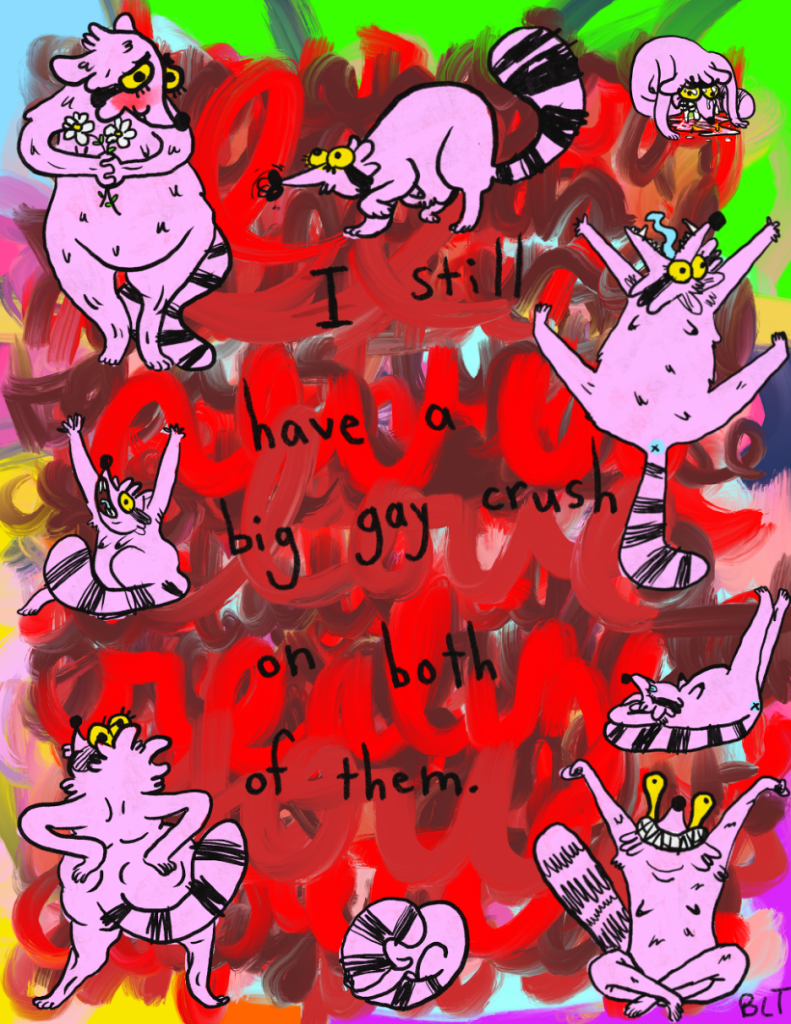
My comics take many forms:
-Sharpie/Tombow/Pencil/Ink drawings on paper/sketchbook with watercolor, or crayon
-Digital drawings on my ipad or scan/photograph them and post the images on social media
-Zines drawn digitally or on paper, then transform those images into a zine book form by first using InDesign and then printing
-Sequential printmaking installations of my crows and climbing Seattles, as well as my screen printed splash pages from Garen’s Diary
-Soft sculptures of dolls and 3-d word bubbles in the situations presented in the graphic novel or comic book and staging them within the gallery space to create an immersive experience
-Huge paintings & panels painted or adhered to panels
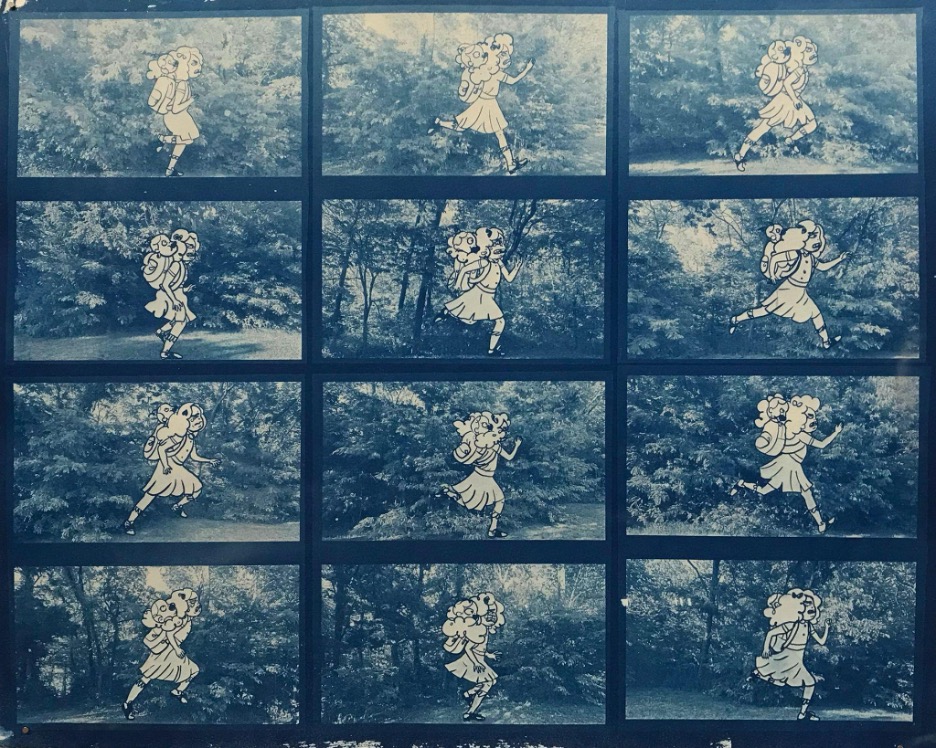
Cyanotype where Seattle is running through the forest, it was made for Sequencer, a print exchange by Nathan Pietrowski and Jon Vogt
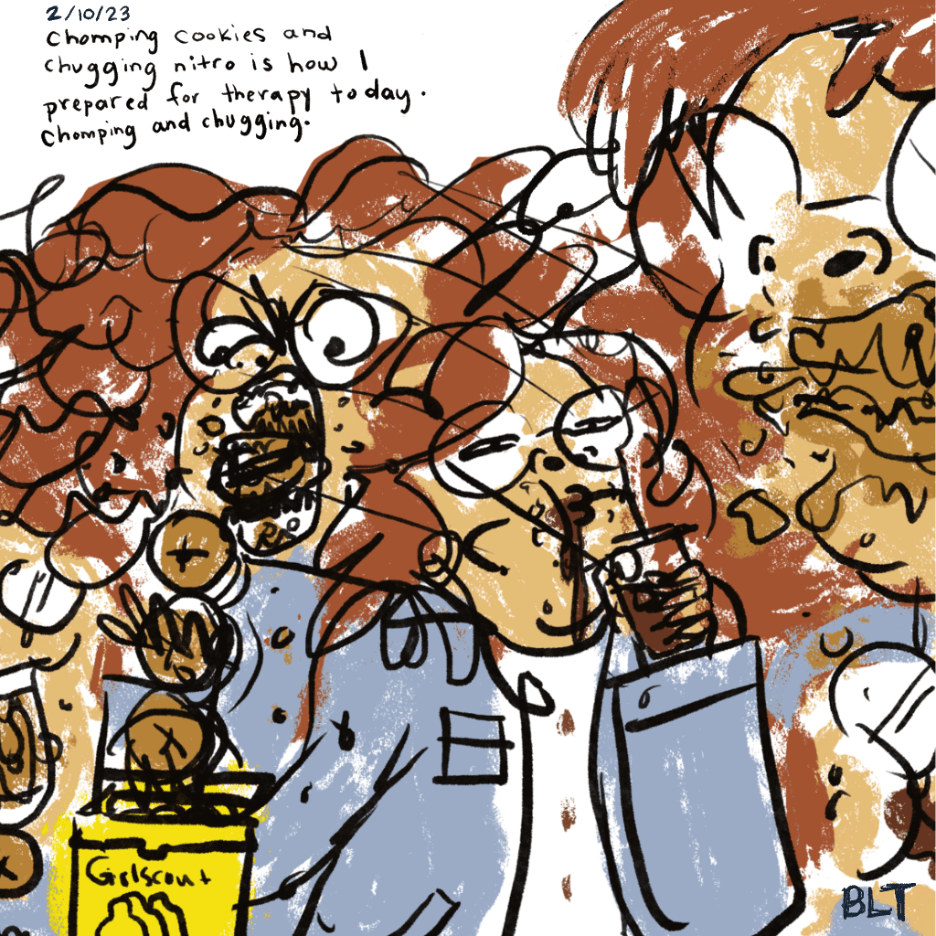
Have you ever been afraid or worried about making artwork that references comics?
Of course! I HAVE been afraid or worried about making artwork that references comics.
I have always had that sinking feeling that people might not take my work seriously due to the fact that it looks like a cartoon or a comic.
However, I am extremely protective of this type of art and I am ready to defend what I do. I guess I am pretty sanctimonious about making comics and referencing comics. I have never had anyone challenge me to my face. Not yet anyway. Either way, when I do, I’ll take it as a compliment because it means my work will have the artistic authority to get people excited in that way.
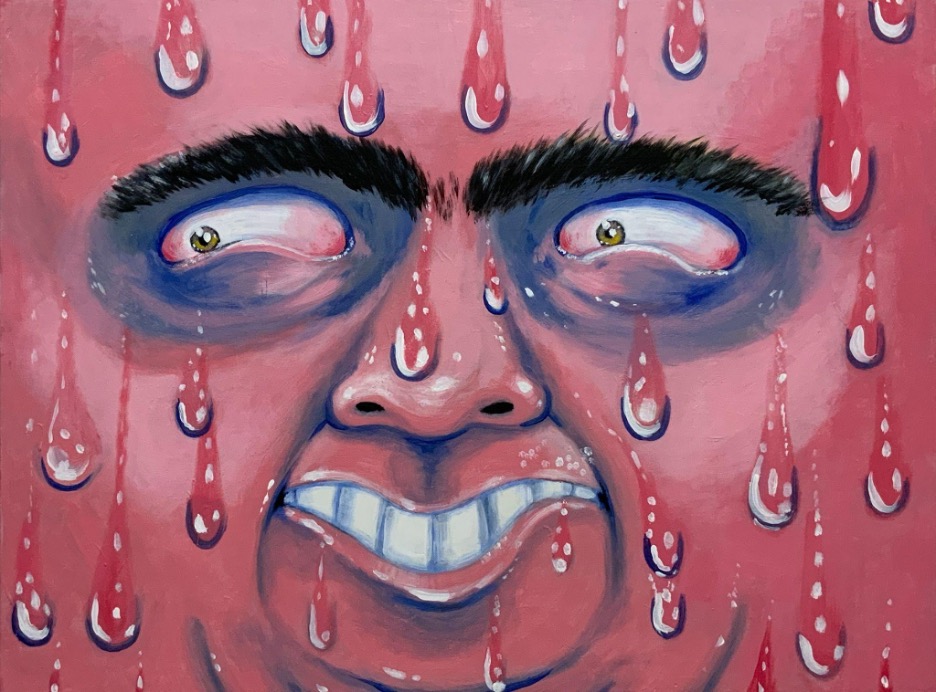
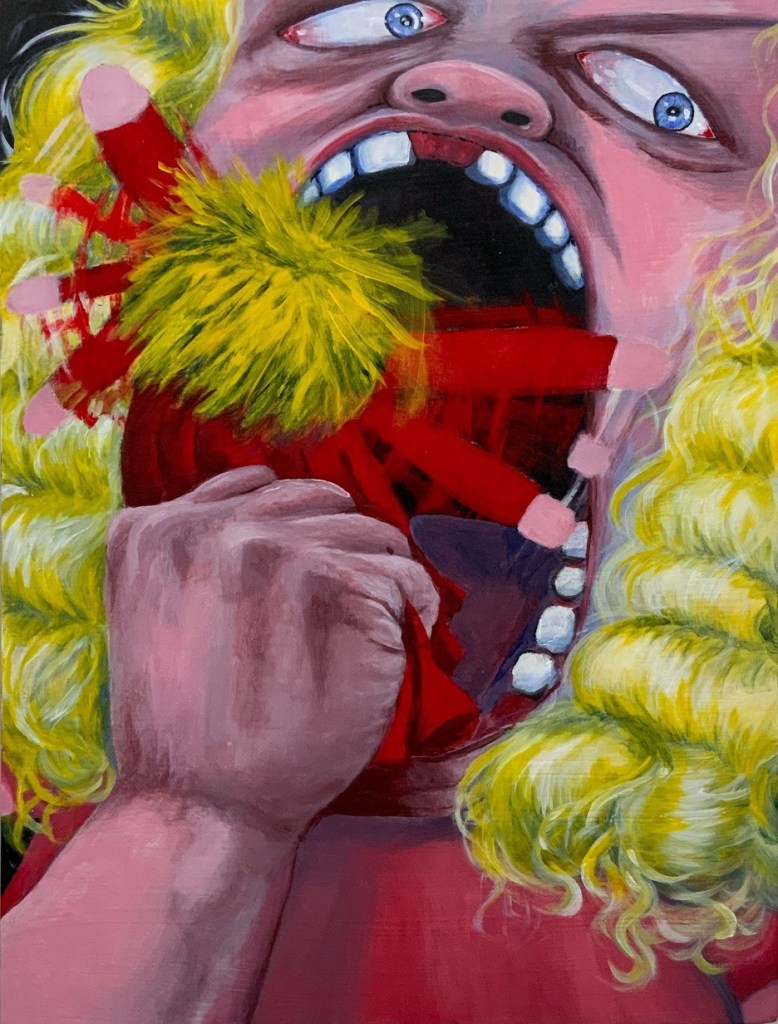
When I make a simple cartoon sharpie drawing into a comic and share it as my art, I am not hoping that my audience “oos” and “ahhhs” over how accurately I was able to draw a thing that I see with my eyeballs. I am hoping to communicate the way something feels as an emotional sensation or experience rather than how it is objectively optically perceived in space. In other words, I’m after the realism of feelings, not the realism of looks. The rendering of feelings doesn’t always require the fanciest materials or the cleanest draftsmanship. It requires a multitude of things that I’m not 100% confident how to explain but I know it has to do with the hand’s application of mark-making, color theory, composition, environment, visual noise, context, human conditions like tears, glossy eyes, showing teeth, nails, body language, etc. So there is the immediate foreground character, but then there’s also the background character, or the environment as a character. The environment has to be felt too in order to really submerge into a story.
This all-encompassing pursuit of trying to deliver a heavy experience experience to the reader drives me and honestly, it’s too distracting to always worry about what haters are going to think. If I make something that excites me, I know it will excite lots of other people who need it just like I do. That thought always knocks out the “what if people hate it” thought. I guess I’ve made a sort of peace with the fact that not everyone is going to like my work, because nobody can claim that everyone likes their work. That’s just part of making anything and sharing it.
BONUS QUESTION (optional): What question about comics or your work would you like to be asked?
Have you ever reached out to your heroes? What was it like? What did they say? How did their words make you feel?
I do want to point out that reaching out to artists that I was moved by was really impactful. Ruby Elliot and I messaged each other quite a bit and talked about art and life. I also messaged Andy Ristaino, and he said that my comics were funny and to keep it up. Even Thurop Van Orman commented on my deviant art and it made a life-long impact! These tiny moments of encouragement that those folx probably don’t even remember have done worlds to motivate and carry me through lots of tough times when I didn’t feel like an important maker or person.
Making an effort to talk to my heroes and connect with the artists who moved me has been so fulfilling and motivating.
Even today, any time I draw a drag queen and they acknowledge it on social media I get butterflies and feel a nice confidence boost.
I really hope that I get to give other folx that same kind of boost in confidence and a sustaining motivation in tough times and throughout their entire lives as my heroes did for me.
 Not Approved by the Comics Code Authority...