Andrew Kozlowski lives and work in Jacksonville, Florida, where they have been making and sharing a weekly comic since 2021. They also teach classes and workshops about comics and Risograph printing.
They post regularly on their Instagram page @andrew.kozlowski, they sell comics and zines from their online store at www.papercitypublishing.com, and their older site www.andrewkozlowski.com has images of work in printmaking and installation from the “before times”.
Andrew is interested in how time works, the creative process, and sharing parts of their life as a father, husband, and teacher.
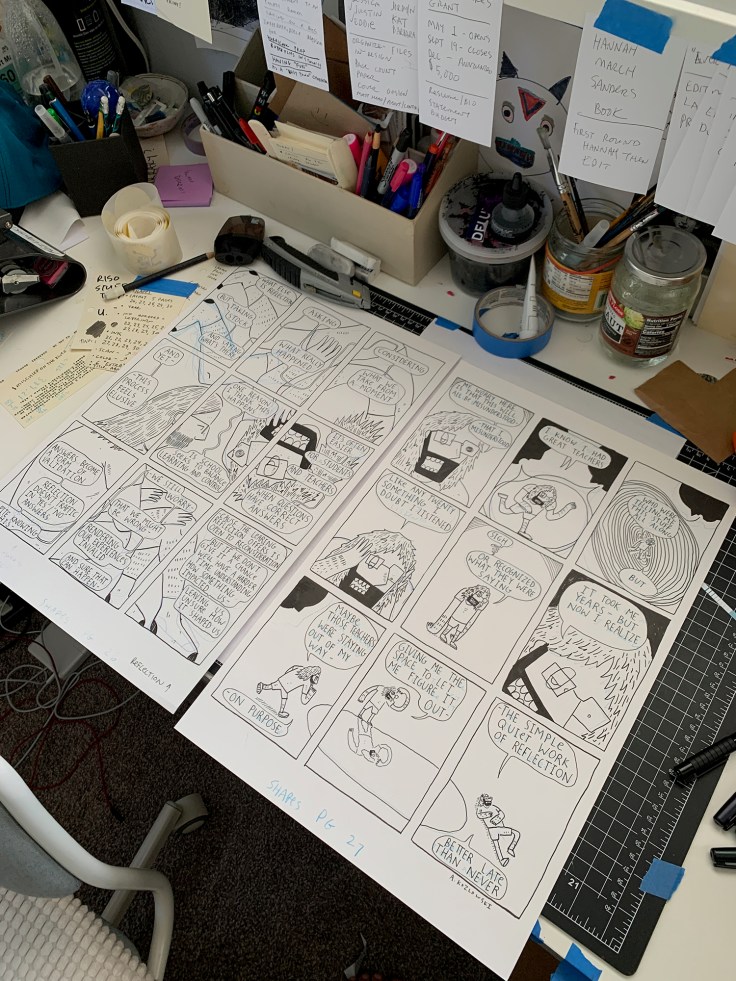
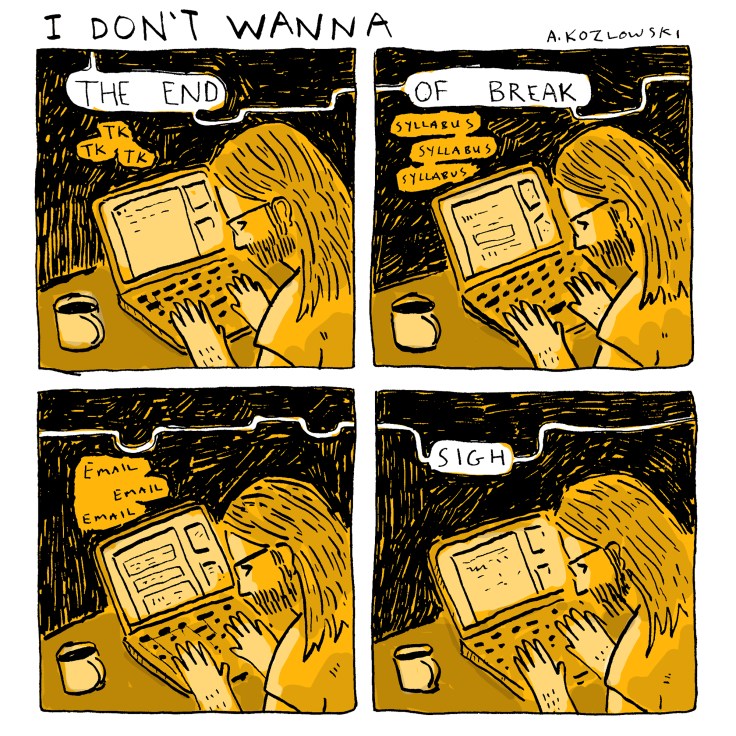
scanned ink drawing, digital color, 2023
Did you grow up reading comics and were there moments when you stopped?
I always say my first art experience was reading Sunday comics. I would read them all, but in an order that would save my favorites for last. Around 10 or 11 my older brother got me into reading X-Men, Spiderman, Deathlok, Punisher– standard Marvel titles. When I was about 13 I hit my stride, this was 1993/94, mainstream superhero comics were filled with foil covers, trading cards, this was also the time of The Death of Superman and the breaking of Batman.
I guess I stopped reading comics by the end of junior high. While comics never truly stopped being a part of my life or work- they’d go dormant at times and pop up here and there, usually when I was feeling lost in what I was doing.
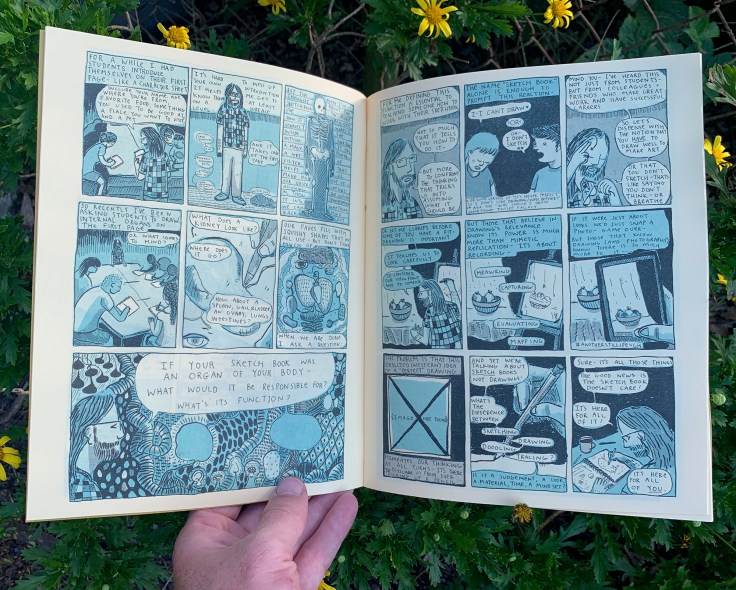
Riso printed comic, 2023
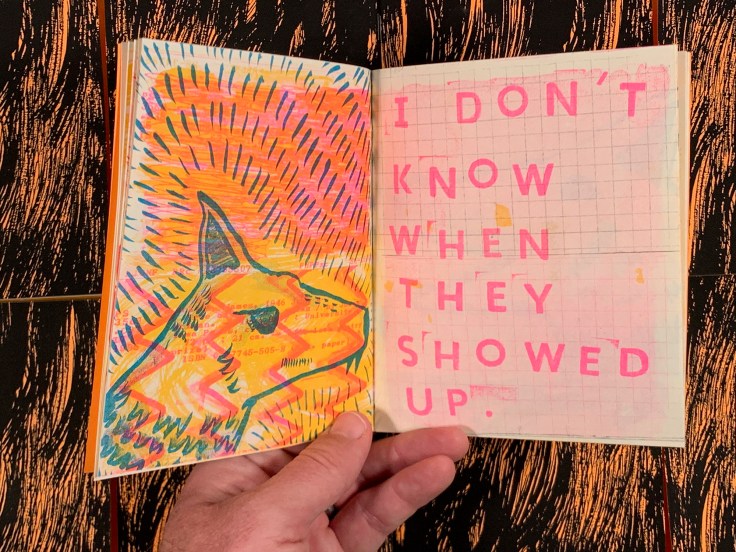
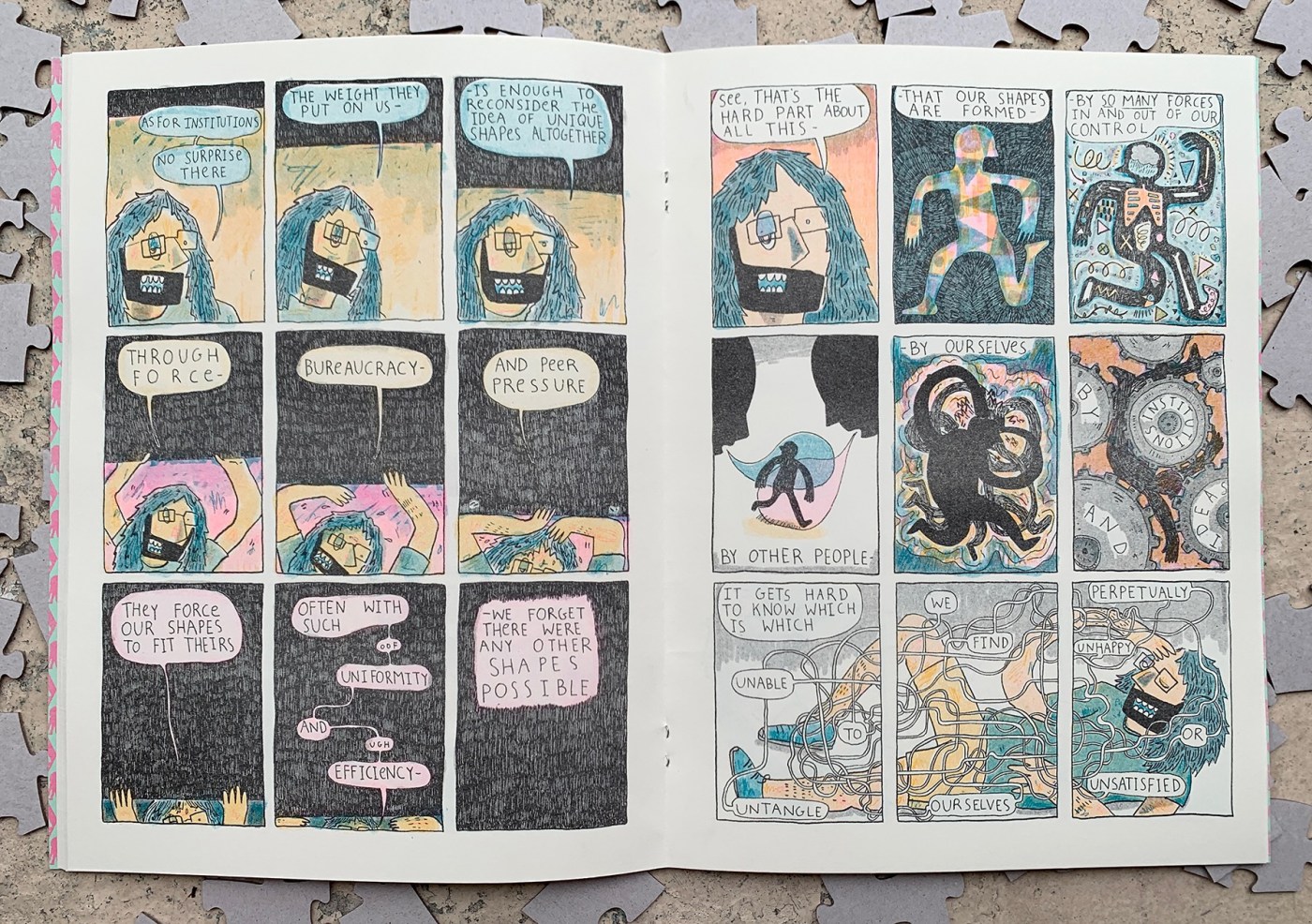
Riso printed zine produced for “Sun Scream Zine” exchange organized by Veronica Leto, 2023.
Did you have a favorite comic shop or an important comic shop growing up?
Yes- a few. When I was 13, an important shop was in the Downingtown Farmers market, I dropped a ton of money in there, but the next shop would come later when I was an undergraduate student at Tyler (School of Art, Temple University). I started at Tyler with thoughts of being a painter, but had flights in the ceramics and sculpture areas before settling into the printmaking department. Side note, one of the best things about Tyler’s curriculum was that we didn’t actually have a major until we were Juniors. Freshman year was foundations, and Sophomore year was spent exploring areas by taking a slate of pre-req courses; for someone like me who just bounced around a bunch, this was perfect.
Comics and narrative were on my mind, and I can’t remember the exact string of events, but in my Junior year I read “Understanding Comics” for the first time. This blew my mind, it so effectively parsed out knowledge about how comics work. Up until that point I’d only ever seen books on “how to draw” or “how to cartoon” (shout out How to Draw the Marvel Way which I read cover to cover at my grandparents house over a weekend). Also during this time I saw Dave Eggers talk, he showed (via a series of printed transparencies) the pencils for a Chris Ware story that had just been published in McSweeny’s 6 (which also came with a soundtrack by They Might Be Giants). The story was a version of “The Gift of the Magi” featuring a frog, a banjo, and unrequited love. All this was capped off with a trip to Brave New Worlds, a comic shop in Jenkintown (just north of Tyler- we were still on the Elkins Park campus). I walked past the shop a number of times, but one afternoon I just decided to go in, and that’s when I found alternative comics. Chris Ware’s Acme Novelty Library, single issues of Charles Burns’ Black Hole, (side note, at this point I didn’t know that Charles was the husband of my amazing drawing teacher Susan Moore), Optic Nerve #8 by Adrian Tomine, and Love and Rockets by the Hernandez Bros.
I tried drawing some comics around this time, but they were awful, and eventually the idea went dormant.
After a few years I arrived at VCU (Virginia Commonwealth University) in Richmond VA, where I joined the MFA program in Painting and Printmaking. After graduation I found myself a bit lost, and ended up collaborating with a friend Anthony who had a similar pedigree (art school, MFA, passion for comics but hadn’t really made any) and we made a few issues of a “comic” that we trucked around to different events (SPACE, SPX, Richmond Zine Fest). We frequented Velocity Comics (on the same block as the art building) which is where I found Lauren Vinestein, Jeffery Brown, and Joshua Cotter, among many others.
I’d stop reading again for a bit, maybe grabbing some graphic novels from the library here and there, but it wasn’t until the pandemic hit that I found myself diving deeper again.
What’s fascinating to me is that comics and storytelling have always been with me, and with each new point in my life I found myself drawn to something new. Comics are so vast and changing and as I’ve grown, comics have too, somehow always offering me something to suit my tastes. I’ve tried to pick up recent Spiderman books, but they just don’t appeal to me. But that’s OK, because there is always something new to fill that space.
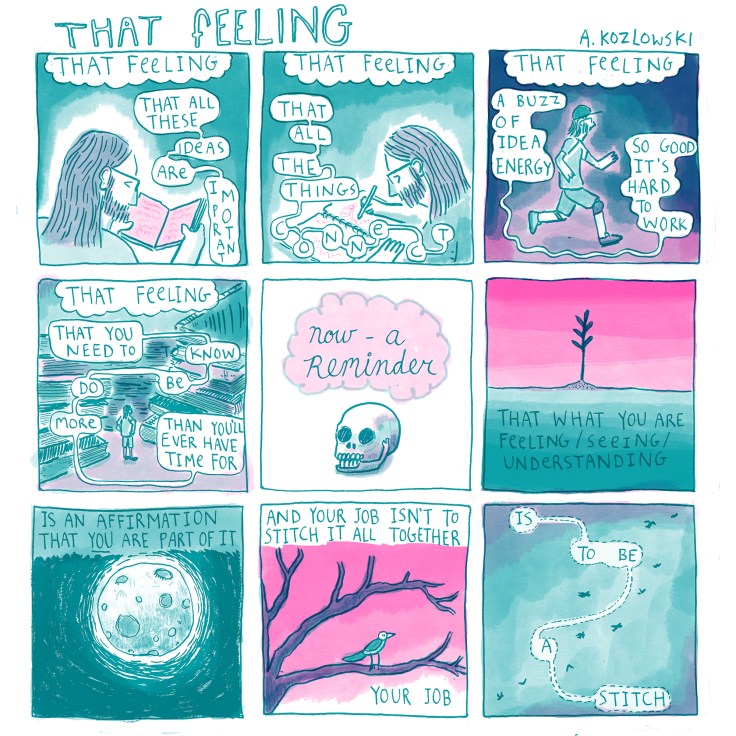
scanned ink drawing, digital color, 2023
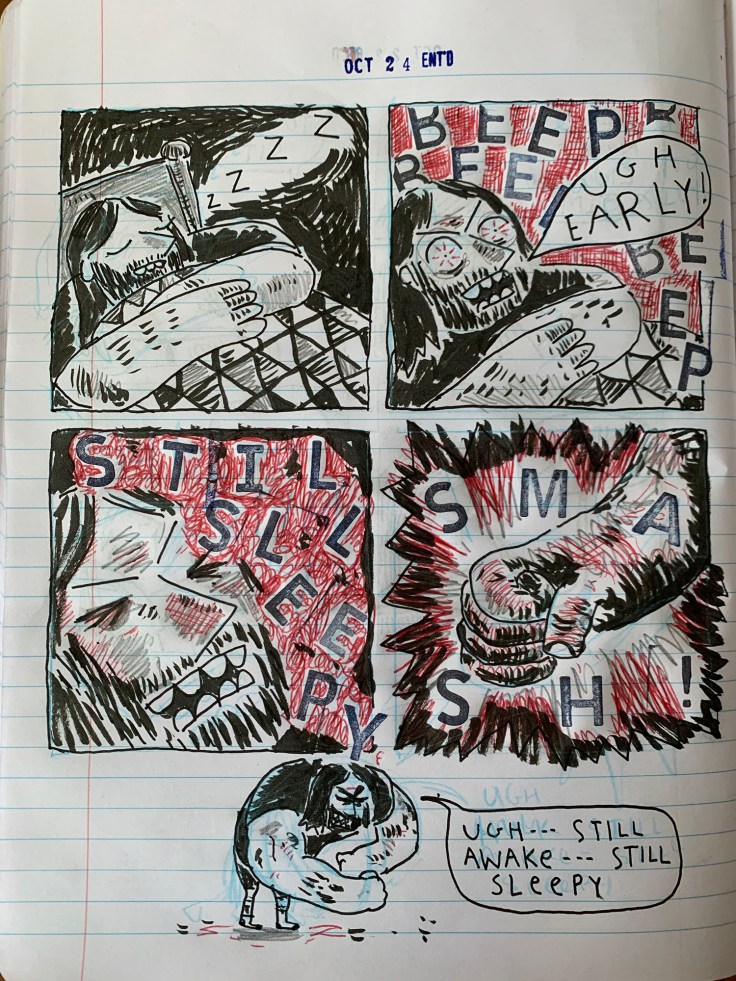
pen and ink on notebook paper, 2023
How long have comics inspired and how do they influence your work?
I say comics have always been an influence. At first, I was interested in the graphic look and drawing style, there is such a strong connection between how comics look and are made and techniques like relief and screen printing. I think there is also a connection between printmaking and narrative given the appeal of reproduction and dissemination of printed materials for sharing stories and propaganda. My taste in comics varies, and especially now isn’t easily defined by their look, but has much more to do with the stories themselves.
One thing I think about as a teacher is how we often tell students to “go deeper” with their influences, and we often hear and see things like comics as being considered “less valuable” or “less critical” (despite the heaps of growing research into the field). So students end up feeling bad for their taste, for what got them into our classroom in the first place. I reflect back on those first art experiences I had, they weren’t high art. For me, it was comics and being in bands and writing songs. Certainly I’ve grown up since then, but these experiences are vital in my development as an artist. If I didn’t give them the time and reflection I wouldn’t make the work I do now. For me, especially recently, the influence of comics has percolated up through the small press/DIY/zine making ethos, which came from my time in bands as a kid, and has come into sharper focus in where I see the trajectory of my teaching and creative research moving.
While I do love printmaking, teaching online during the pandemic raised a lot of questions about accessibility. Teaching comics felt like something that worked well in that environment, and it was inexpensive, we could do some heavy lifting with just a pen and some paper. The open landscape of comics just offers so much, it invites a range of voices and stories, and it doesn’t require the same kind of foundations introduction that art curriculum often asks. I purposely developed my Comics and Narrative class without prerequisites, with the hope of drawing students from a range of disciplines.
I’ve found these influences and voices echoed in the work of Lynda Barry, Sister Corita Kent, and adrienne maree brown. Here in Jacksonville, I’ve found a group of like minded artists, writers, and makers who are helping to build and promote zines and comics. Post pandemic, there seems to be a surge in looking for these person-to-person connections. I found myself drawn to the idea that I could use my knowledge of storytelling and bookmaking to help others build and tell their stories. That publishing and editing could be natural extensions of curating and teaching.
Last year I wrote a grant for a Riso Duplicator, and I got it! My goal is to work with artists, writers, designers, journalists, students, community members to use this DIY ethos to help make connections, to start moving from not just self expression, but towards an idea of community expression.
In Fall 2023 I taught a new class called “Zines and Community” where students worked with community partners to help tell their stories. The idea of the class is that students learn to use their skills as artists, designers, and writers to work with community partners to help them amplify what they do. The community based learning aspect of the class was very new and scary to me, but it was really well received by the students and my colleagues, there is a push for CBL at my school and I think this class is a way for me to help expand the arts beyond our usual territory. I look forward to running the class again in the future.

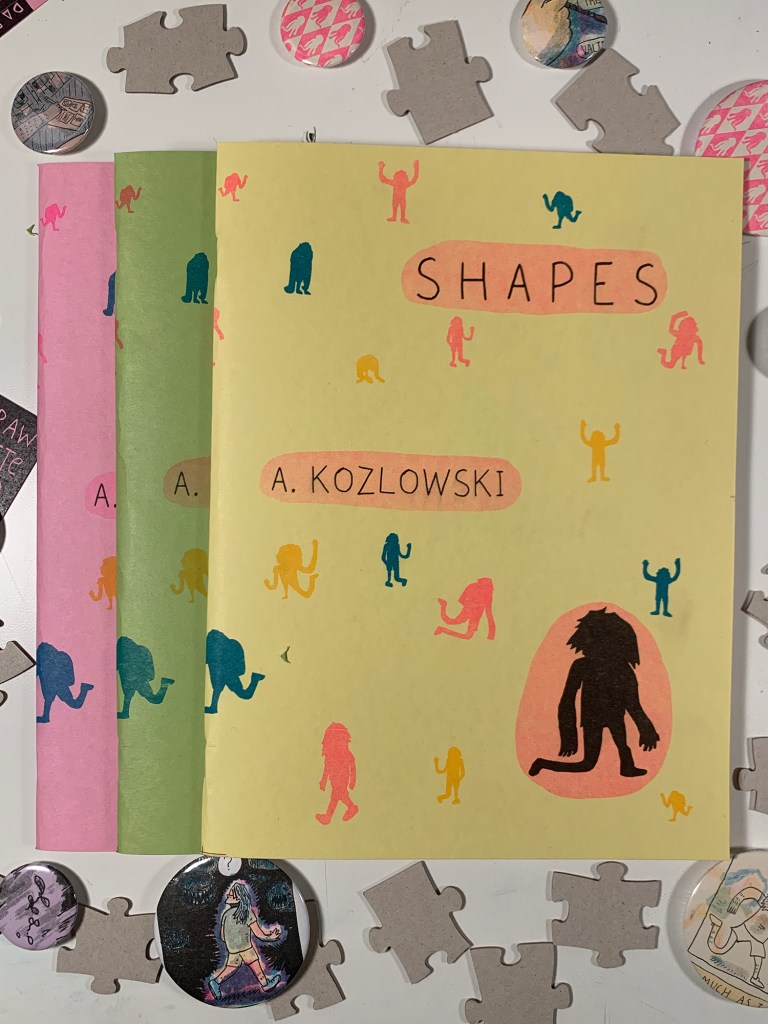
40 page riso printed comic, 2023
BONUS QUESTION: What worries or concerns do you have?
A question I ask myself is what does an arts curriculum look like in 10 or 20 years?
I see a great deal of potential in comics as a device to open up the arts, and specifically to teach creativity and creative thinking through story sharing, but I worry about how all this gets valued as an academic. Beyond the usual ignorant statements about comics not being art, which I think just shows a lack of awareness regarding how far comics has come as a scholarly topic in the past 20-30 years. What I’m thinking of is the challenge of sharing these practices through channels that fit traditional frameworks of teaching and research.
I know I can’t use the phrase “self-published” in my T&P dossier without push back, but what if I start my own publishing imprint? What does “peer-reviewed” mean when I’m more interested in removing the kind of scarcity/limitations/gatekeeping that comes along with that mode? What if we all told and shared stories? Zine history/culture is remarkable in how it sprung up around the accessibility of printing and flourished through the kind of human to human contact that we recognize as so important (especially post-pandemic). The openness of zine making made it possible for non-mainstream voices to be heard- and generated a wealth of work and ideas that many academics have gone on to build careers out of.
As a printmaker, I’ve always heard a lot of talk about the “democracy” of printmaking, but I still see a focus on the niche, the limited edition, the process and tools. Don’t get me wrong, I love all that eccentric stuff, but I guess I’m finding myself valuing comics and zines as a place where that knowledge, that democracy, has a moment to flourish through the accessibility and encouragement of a community that doesn’t really need much more than a pen and piece of paper to start.
I’m hoping that the trajectory of my work as an artist, a publisher, and a teacher, can help be part of keeping that community open. In the end I value the process of creative thinking as a crucial aspect of human development, alongside math and writing, in fact I’d argue it is the most important of the three. The wider we open the door, and the longer we keep it open, the more people we can invite in to recognize their own potential as creative thinkers and we can all benefit from this exchange.
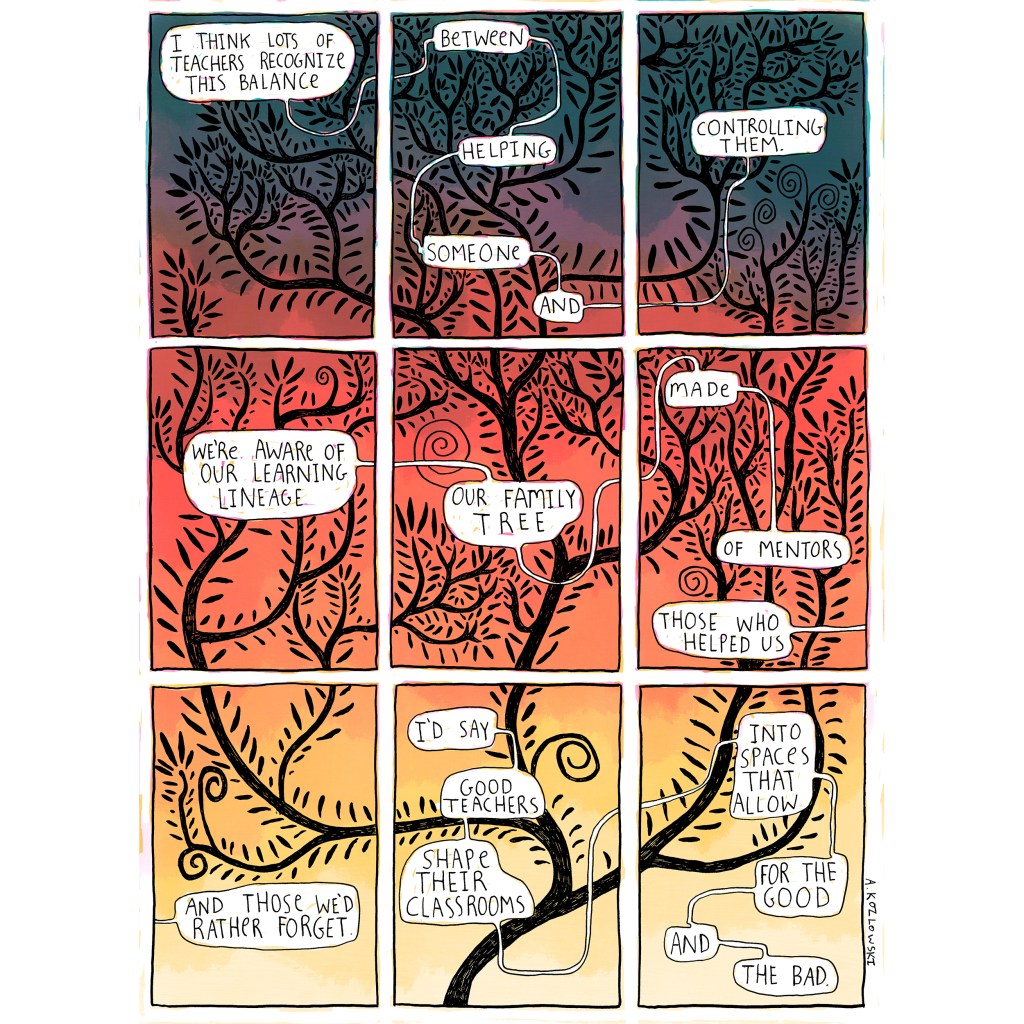
Scanned ink drawing, digital color, 2023
 Not Approved by the Comics Code Authority...